
ROARING FORK BROADCASTING COMPANY



Editor’s note: Eggheads meet cowboys in this first of a two-part story from Aspen Journalism about Herbert Bayer’s journey from Austria to Aspen. Indelibly shaped by World War I and his studies at the German Bauhaus design school, circumstances chronicle Bayer’s hasty exit in 1938 to escape Adolf Hitler and settle in idyllic 1946 Aspen as Walter Paepcke’s go-to designer in the reinventing of the town.
Taking in the volume of multimedia work by Herbert Bayer (April 5, 1900-Sept. 30, 1985) in the world of graphic design, art, sculpture, photography, typography, architecture, earthworks and even philosophy is like trying to read too many novels at the same time. Although he occupies a niche in the pantheon of polymaths, wherein Leonardo da Vinci and Michelangelo are pillars, Bayer restyled the 20th century art/graphic world with the breadth of his creative genius and his infographic distillations of information into visual simplicity.
As a standout alumnus of the Bauhaus art, craft and design school where he studied and then taught between 1921 and 1928 in Germany, Bayer’s international popularization of the modernist style of the bare-bones Bauhaus brand became synonymous with his name. While living in Aspen between 1946 and 1975, he was the carte blanche designer of modern town shaper Walter Paepcke during the transition from mining and ranching to skiing, but few realize how Bayer’s pivotal contributions to midcourse Aspen shaped what town is today.
From litter and billboard blight to zoning, from yard-fence shapes to chromatically painted Victorians, from refurbishing the Hotel Jerome and Wheeler Opera House to modernizing birdhouses and creating the iconic Aspen leaf logo, much of Aspen still reflects his inspiration. But his crowning achievement was the synthesis of all his art forms into the comprehensive design of the Aspen Institute campus, based upon the German concept of Gesamtkunstwerk, meaning a “total work of art,” or a total aesthetic. In this way, Bayer’s design of the campus merged the small to the large without interrupting the horizon.
While the Chicago businessman Paepcke’s post-World War II neo-Greek ideal of developing body, mind and spirit in a backwater mountain community launched Aspen on an inadvertent course to the immoderate extreme that it is today, the hubris of his followers in the 1950s collided with the status quo of the original settlers who had already shaped a place to their liking since the mining days of the 1880s and 1890s. Denver newspaper wags followed the mutation of their cousin over the hill and dubbed the rub “town versus gown.”
Bayer’s diverse portfolio of modern, ruminating paintings still populates prestigious international galleries and exhibitions. His sculptures still punctuate cityscapes and his elegant 1966 U.S. Postal Service stamp depicting the Mississippi River basin is a collectible. Yet, one need not search further than the new Resnick Center for Herbert Bayer Studies at the Aspen Institute and the Herbert Bayer Collection at the Denver Art Museum for a detailed glimpse of his enormity. In a continuing series of exhibitions at the Center for Bayer Studies different periods of his career are highlighted, including the most recent exhibition featuring his 1953 “World Geo-Graphic Atlas: A Composite of Man’s Environment,” which alchemized reductive clarity into cartographic presentation.
In a Feb. 4, 2020, Smithsonian Magazine story, “Pioneering work of Herbert Bayer,” Wendy Noonan recounted how in 1939 Bayer pondered his pursuit, asking, “Why is it difficult to be simple?” Chasing this lifelong leitmotif, he refined utility and visual spareness in his structures, while trying to find time for his true passion as an interpretive painter, which he called “the continuous link connecting all the facets of my work.”
During his Aspen residency, he kept a rigid daily schedule of work from 9 a.m. into the evening in his studio, wearing a pressed white shirt and ascot, said local painter Dick Carter, who apprenticed with him in the early 1970s. Throughout his Aspen years, Bayer completed more big projects than seem humanly possible, yet he also found time for whimsey.

Rewinding to his halcyon days at his first Aspen residence, a May 10, 1951, Aspen Times story on birdhouses designed by Bayer underscored the Bauhaus theme of art and function in the garden at his and his wife Joella’s Victorian on West Francis — formerly 1890s Colorado Gov. Davis Waite’s home. But what showcased Bayer’s genius is how he dovetailed motion into art by mounting the avian housing atop tall half-inch plumbing pipe, so their nests would sway treelike in the breeze.
Using the basic geometrics of circle, triangle and cube, painted with his preferred crisp primary colors, Bayer said the birdhouses would add color to the stark, early-spring gardens of Aspen, where flowers bloom late at altitude. One of the designs was a wasp-nest-looking abode made of paper mâché shell built around an inflated beach ball, which he removed from the inside. He then sealed and painted the roundhouse white and decorated it with abstract plant forms, adding a red perch. His secretary, Kathryn Puterbough, commented, “It’s the roomiest birdhouse I’ve ever been in,” the Aspen Times wrote.
Nearby, he built a wooden bow-tie duplex of two triangle birdhouses with painted aspen leaves and matching pink entryways. Another — a cube-shaped birdhouse colored blue, white, red and yellow — adjoined the backyard subdivision, which together illustrated an essential Bauhaus refrain: Form follows function.
Born in 1900 in Austria, then part of the Austro-Hungarian Empire, Bayer innovated beyond the previous century’s art and design — from the exactitude of realism to the new light and movement of impressionism — in his style of 20th century modernism.
As a boy, he liked to sketch alpine scenes while following his father, a tax collector, into the mountain villages. This led to his joining the Wandervögel (meaning wandering bird), a quasi-uniformed idealist German youth movement of students who hiked and camped in the mountains, eschewing urban life and advocating a return to simple folkways. While attending school, geometry was a favorite subject. These pursuits planted the seeds of preference for simplicity and geometric shapes in his later Bauhaus studies.
After apprenticing with different architects and hoping to enroll in the The Academy of Fine Arts Vienna, the death of his father in 1917 led to his enlistment in Austria’s 14th Infantry Regiment near the end of World War I. He served in the Medical Service, where lice, dysentery, bombardment, gas attacks and unimaginable carnage confronted medical attendants and the heroic stretcher bearers who fetched the wounded from the battlefield back to blood-soaked trench infirmaries. The trauma that the young Bayer experienced probably contributed to his search for order in design, along with trying to reduce the inexplicable into palpable form — what veterans of combat have always faced.
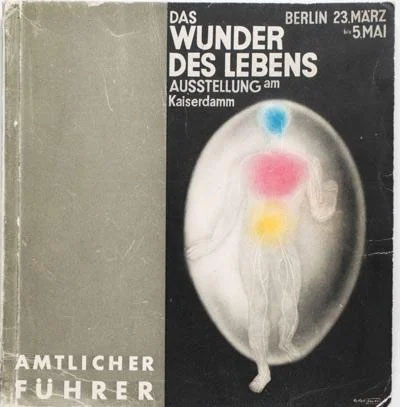
A book cover from 1935 with an illustration by Herbert Bayer showing an ideal-man concept, part of the Nazi propaganda campaign for eugenics called “Wunder des Lebens,” or the wonder of life. Bayer’s work for the Third Reich, which he maintained he performed to protect his family and called “his purgatory,” remains as a clouded part of his history. He fled to the U.S. in 1938. Biblio.com
While attending the Bauhaus school, founded by visionary architect Walter Gropius, who premised equality of trade-craft skills alongside visual arts, whatever genre Bayer applied himself to generated his natural mastery. At the same time, he was inspired by modernist painter and theorist Wassily Kandinsky, who advocated that art should serve society. Bauhausians further preached that craft and art should improve people’s living conditions through modern design. As Bayer’s innate talents ripened, Gropius soon elevated him to teaching master — but not without incident.
In 1925, Bayer married American-born Irene Angela Hecht, a photographer documenting the Bauhaus. They had a daughter, Julia, in 1929, but separated in 1932 because of his infidelities. Yet, they didn’t divorce until 1944. According to a July 7, 2014, New York Times story by design critic Alice Rawsthorn, “Exhibition Traces Bauhaus Luminary’s Struggle With His Past,” Bayer was “an inveterate womanizer, who had had a string of affairs, including one with Isa Gropius, which had imperiled, but not ended, his friendship with her husband Walter.”
Gropius bore war baggage as well; he had seen 80 of 300 men in his cavalry unit killed in one hour of battle and “late in the war had been buried alive for three days,” the Times said. Yet, after those horrors and with the hopeful democratic socialism of the Weimar Republic following Imperial Germany’s defeat, a new idealism of starting from scratch trended among European youth — dubbed the “lost generation”— who came of age in the rubble of destruction.

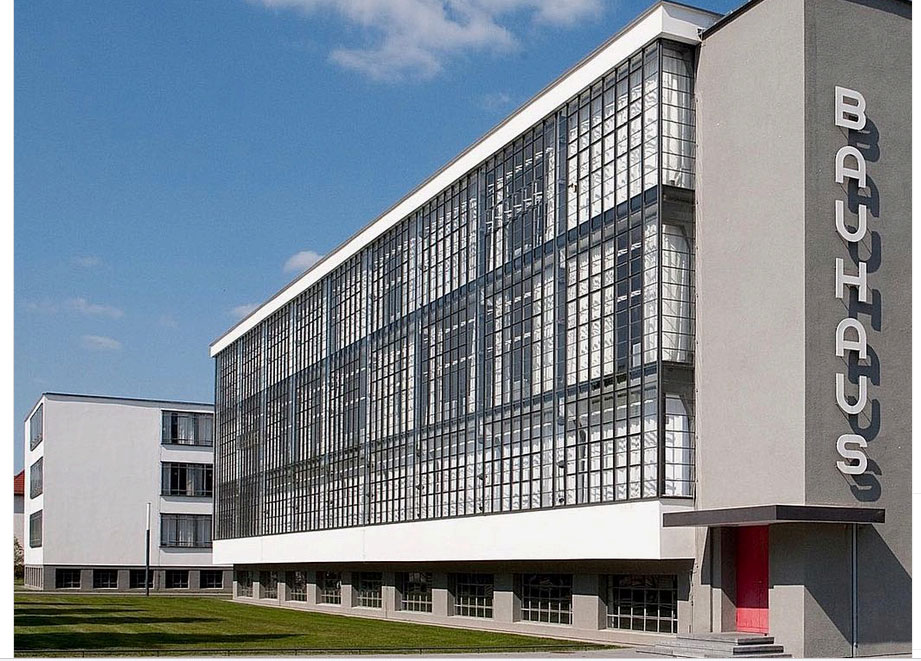
A postwar meme then was “Starting from zero,” meaning that from the ruins something new rises. Pursuing this theme, the varied students who gathered around Gropius in 1919 when he started the new Bauhaus in the city of Weimar aimed to strip the bark off existing “bourgeois design” and create form without applied decoration. Into this setting, Bayer enrolled in 1921.
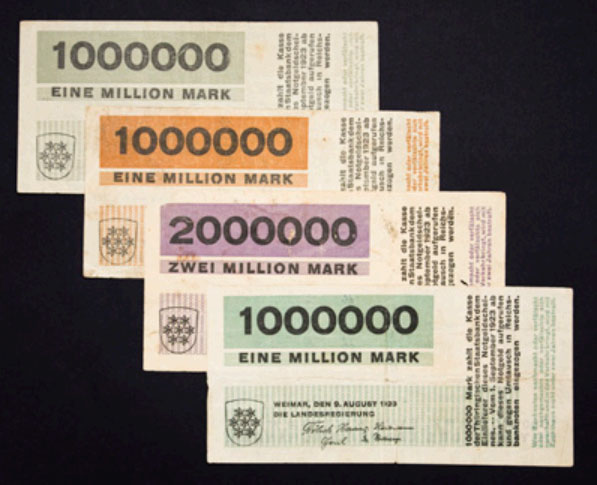
In 1923, at the age of 23, he designed new banknotes in denominations of millions of Papiermarks, or “Marks,” for the struggling Weimar Republic, Germany’s first attempt at democracy, then battling hyperinflation brought on by war debt needing to be paid in asset-backed currencies. Concurrently, persuasive nationalist and fascist opposition agitated that the war loss and 1919 Versailles surrender was a conspiratorial lie.
Bayer fashioned block-numbered notes in Bauhaus font devoid of any traditional heraldry and portraits, which became immediately valueless as the mark rocketed to 4 trillion marks per U.S. $1 in late 1923. (It was 4 marks per $1 in 1914). People burned wheelbarrows of bank-note blocks to keep warm because it was cheaper than buying wood. That same year, Hitler led a failed government coup and was jailed for treason, writing “Mein Kampf” while incarcerated. Getting out early, he demagogued his pro-strongman followers until succeeding in taking power in 1933. That same year, his Nazi party condemned modernism and shut down the Bauhaus school, which had migrated from rising oppression in Weimar to Dessau in 1925, and then from Dessau to Berlin in 1932.
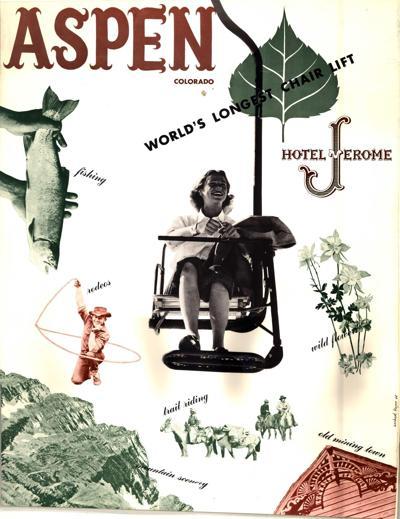
In his 1981 book, “From Bauhaus to Our House,” irreverent cultural writer and diction acrobat Tom Wolfe contrasted “coziness and color” versus the “leanness, cleanness, bareness and spareness” of modern architecture. So much subtraction made a home look like “an insecticide refinery,” he said. Blaming Bauhaus for spawning such austerity, he described the creative scene there in the 1920s as “a commune, a spiritual movement, a radical approach to art in all its forms, a philosophical center comparable to the Garden of Epicurus,” with Gropius as Epicurus.
Applicable to Wolfe’s deconstruction of Bauhaus rigidity is a term he coined at the annual Jefferson Lecture in the Humanities in 2006: “fiction-absolute,” wherein “an individual adopts a set of values which, if truly absolute in the world — ordained by some almighty force — would make not that individual but his group … the best of all possible groups, the best of all inner circles.” A bit of this air of rediscovering original essence freighted the Bauhaus, Wolfe posited. As a concept, fiction-absolute can still help us see through ideologies and discern knowing from believing.
An April 22, 2019, New Yorker article by Dan Chiasson on the Bauhaus scene, “The Man Who Built the Bauhaus,” reported that Gropius’ first wife, Alma, a vivacious Viennese woman, was “repelled by the high-minded diet of ‘a mush of fresh vegetables,’” and saw the Bauhaus as not “refined by clean lines and materials, but by ‘garlic on the breath,’ coming out of ornate and overdone 19th century architecture.”
That said, Bayer honed his skills there, boldly designing the “universal alphabet” font. His new lowercase lettering threw overboard the ornate German Fraktur type — resembling monk-scribed, medieval papal bulls — and eliminated decorative flicks (called serifs) from the letters, thus siring the many serif-free fonts abundant today.
Suggesting that no one speaks in uppercase letters, his original geometric font could be drawn with a ruler and compass. Yet, this unadorned typeface sometimes appeared in all uppercase, when both became the official Bauhaus font on Bayer’s pictographic posters, brochures, prints, magazine covers and advertising illustrations. He refined this further in the 1930s using suggestive, visual messages, while minimizing or eliminating explanatory narrative.
Well before 21st century technology frog-walked us into the future and delivered messaging rat-a-tat onto every screen in every hand, Bayer’s succinctness was considered a leap forward in rapid communications. Back then, eye-grabbing pamphlets passed out on street corners, graphic-messaging poster art wheatpasted to city walls, hard newsprint and word-of-mouth spread promotional messages more slowly. After the Bauhaus, during his Berlin years between 1928 and 1938, he excelled at such infographics, while surrounded by the promiscuous cabaret scene that nettled the growing fascist sentiment, as Jewish musicians packed up their instruments and people greeted one another in the streets with Nazi salutes.
Though never a known Nazi sympathizer, his neo-bulletin skills still occupy a chapter in Bayer’s life that remain clouded by his Third Reich propaganda work. With a Jewish wife, relatives and friends, one view deduces that he protected himself and his family by taking the uncredited contract work from a third party to make a living and not attract controversy. Another interpretation asks why he chose to be apolitical and not take a stand against the inherent evil of genocide and Aryan eugenics and leave Germany earlier as Gropius and others did.

In any case, Bayer produced affecting graphic designs for Nazi Germany before World War II, including “German People, German Work” (1934), “The Miracle of Life” (1935) and “Germany” for the 1936 Berlin Olympics,” Timothy Brown summarized in an Aug. 1, 2019, Aspen Times Weekly story, “Contending with Herbert Bayer’s contributions to Nazi propaganda.”
Another 1936 brochure cited by Rawsthorn in the 2014 New York Times piece, titled “German Youth in a Changing World,” epitomized Nazi propaganda. The cover featured “a handsome blond-haired boy wearing a Hitler Youth uniform, smiling confidently as he gazed into the distance, one hand gripping a German swastika flag. … This paean to the Hitler Youth movement was designed by Herbert Bayer.”
Brown also reported that renowned Bayer expert and biographer Patrick Rössler, after examining Bayer’s personal papers and diaries, found “nothing that could be interpreted as an endorsement of Nazi racial or eugenic policies.”
While Bayer’s visually haunting agitprop for the Third Reich circulated unattributed to him, he and other modernist painters were condemned as a cosmopolitan pollution of German culture and scapegoated in 1937 to the Nazi’s “Degenerative Art Exhibition” in Berlin. Selected works, including Bayer’s, were purged from the museums along with several thousand “degenerative” paintings, then either destroyed or sold to feed the growing German war machine.
Suddenly spotlighted and out of favor, Bayer left Germany in 1938 for New York, where Gropius had been commissioned to do a Bauhaus exhibition at the Museum of Modern Art and had asked Bayer to help. In whatever mutability of their separated arrangement, Irene stayed behind and gathered his portfolio for the show before joining him in New York with their daughter.
At the same time, numerous European painters — cubists and surrealists — and even Freudian psychoanalysts were immigrating to the U.S., as Hitler radicalized Germany, annexed Austria in 1938 and marched into Poland in 1939, triggering World War II. Along with Bayer, Gropius and a smattering of Bauhaus architects were among this welcome influx of European cultural elites who would influence modern U.S. art and architecture. Much of the sleek steel and glass architecture of skyscrapers in U.S. cities today can be traced to the Bauhaus brand.
Gropius was so esteemed that he became head of Harvard University’s School of Architecture between 1938 and 1952. Meanwhile, Bayer’s artwork was exhibited in major galleries and his minimalist ad-style for the Wanamaker department store and J. Walter Thompson advertising agency attracted Paepcke, who convinced him to move to Aspen in 1946 by offering dual positions as designer for the new Aspen Ski Corp. and art consultant for Paepcke’s Container Corp. of America.
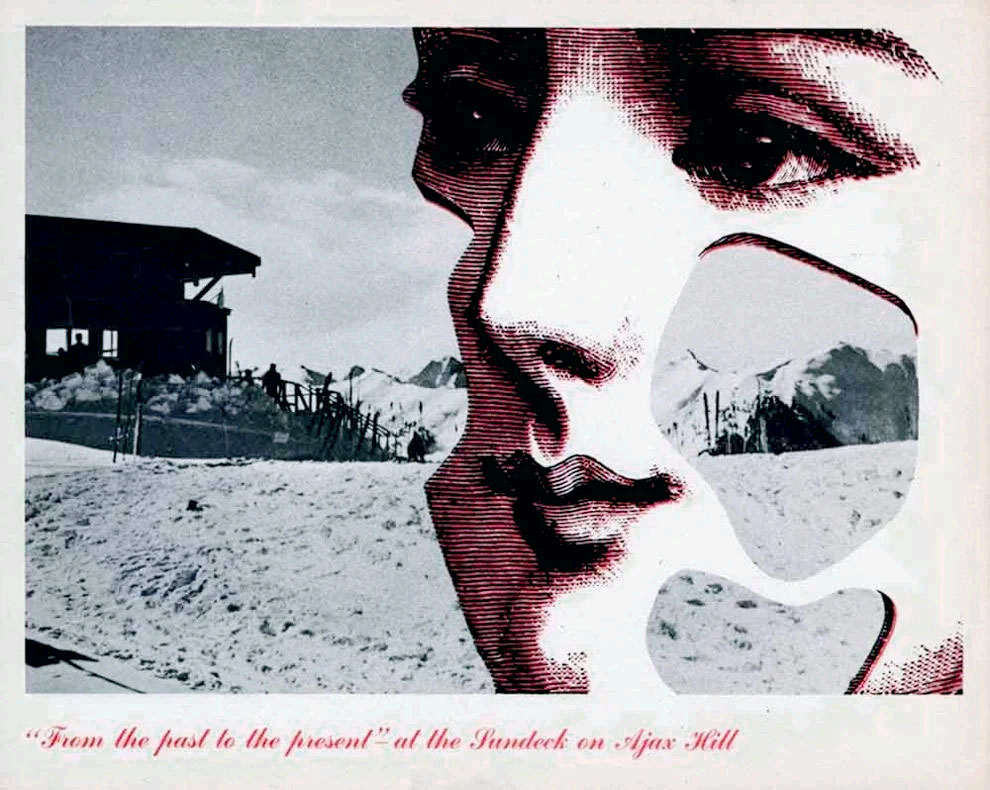
One of Bayer’s initial chores for Paepcke was to design the first Sundeck on top of Aspen Mountain in 1946. He fashioned an octagonal building with 360-degree views around a circular fireplace in the center that could warm wet-wooled skiers without blocking anyone’s view. Without a water source then, he designed a funnel-shaped roof to melt the fallen snow from the fire warmth into a water tank. But leaks developed and the wind blew the snow off the roof; so, they hauled water up the Midnight Mine Road in a tank behind a dozer that first year. After a stellar opening day on Jan. 11, 1947, featuring brand-new Lifts 1 and 2 and 20 inches of new snow, they replaced the roof that summer.
In 1956, Bayer redesigned the Sundeck with another circular lower-level area built around the original, adding an apartment and expanded food facilities. Wind-breaker windows were added to the outside deck. With upgrades in subsequent years, the original octagon lost its stand-alone distinction. The current Sundeck replaced the old structure in 2003.
Bayer also redesigned the lift shacks and ski patrol headquarters on top of the mountain — the latter built in the early 1950s next to the top terminal of the former Lift 2. He chose white and brown with red trim, with new siding for the buildings and blue lift towers with red chairs. Since the old ski patrol building on top represents the last of the Bayer design on Aspen Mountain, some say it deserves to remain.
When Walter and Elizabeth Paepcke arrived in the mid-1940s, mining pioneers, ranchers and second-generation Aspenites were carrying on in a small, self-sufficient town with local businesses, resident tradesmen and a sufficient workforce. As they set out to remodel Aspen, the Paepckes believed that a utopia of Americana and the intelligentsia could coexist. But hayseed status quo took a back seat to the allure of prosperity, causing some local resentment, as Aspen became an international ski resort coupled with a world-renowned think tank.
With money from his Container Corp. of America, Paepcke founded the Aspen Ski Corp., the Aspen Institute for Humanistic Studies, the Aspen Music Festival and the International Design Conference (IDCA) — a cross-fertilization design swap headed by Bayer in 1951 that lasted until 2004. In 1949, to kick off the new era, Paepcke and his wingman Bayer conceived a festival celebrating the German philosopher-poet Johann Wolfgang von Goethe (1749-1842).
Goethe, a polymath and German literary giant, was known for the Sturm und Drang (storm and stress) German literary movement that valued emotion and individualism in novels, while he explored how to reckon the whole with the parts, individual and community, into a working whole. Although a highfalutin dissection to bedrock Aspenites at the time, there’s irony in how that unresolved theme is still playing out in Aspen today.
Nevertheless, the Goethe committee recruited physician and theologian Albert Schweitzer to anchor the three-week festival of noted intellectuals, and even enlisted Herbert Hoover as the honorary chairman (he didn’t attend). Accounts say that Schweitzer was a difficult houseguest at Paepckes’ home because Schweitzer played the piano at all hours, and that renowned “Our Town” author Thornton Wilder held witty court in the Jerome bar from 5 to 7 p.m. daily.
With the Wheeler Opera House still boarded up from a 1912 arsonist fire, the Goethe organizers put up a used circus tent over a new cement-bowl amphitheater designed by Eero Saarinen — whose credits also include the Gateway Arch in St. Louis — to centralize the venue on the 120-acre Aspen Meadows property Paepcke had purchased, which included the town’s horse-racing track and rodeo grounds.
Time and Life magazines covered the three-week fest, which featured a Bayer roundtable on Goethe and art and wrapped up with a talk on “Goethe and world unity.” The Minneapolis Symphony and pianist Arthur Rubenstein played, along with Black opera singer Dorothy Maynor. About 2,000 attendees arrived from every state except Alabama and Mississippi, according to the Colorado Encyclopedia. That one-time gala blossomed into the Aspen Institute and annual Music Festival.
Meanwhile, Bayer had his hands full refurbishing Paepcke’s multiple Aspen real estate acquisitions, much bought on the stealth to avoid local alarm. Herbert and Joella recounted those early days in a transcribed 1980 interview by Erica Gruen, archived at the Aspen Historical Society.
Therein, Bayer intimated what many original locals resented about the Paepcke influx, by characterizing old Aspen with a lingering tint of patronage. “There was a community, but it was sort of a dead community. Only the old leftover miners and their families, only 650 people. … We developed skiing first because it was nearest at hand, and then developed the Aspen Company, who took up building accommodations.”
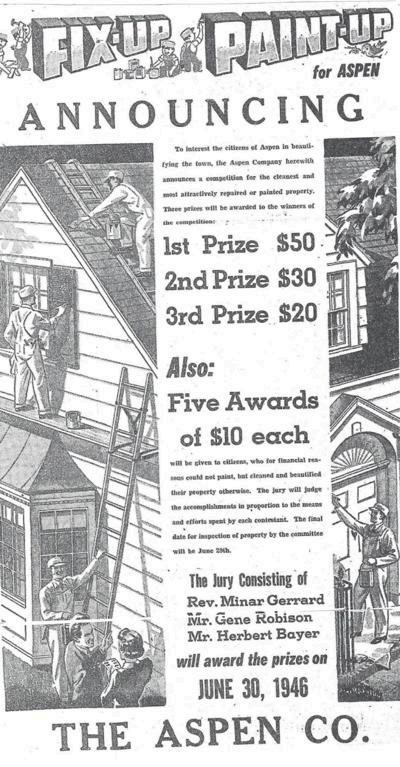
With Paepcke securing a lease on the tattered Hotel Jerome in January 1946, he charged Bayer with the remodel, while their Aspen Company bought eighteen Bayer-chosen houses downtown for refurbishing, Bayer recounted. As Aspen’s first short-term rentals, the Jerome managed these houses to accommodate skiers and visitors. Bayer simplified the interiors and experimented with his brand of bright, chromatic-colored paint jobs. This led to controversy that touched local nerves further. In a bid to clean up the ramshackle town where people abandoned cars in empty lots and dumped their garbage, tin cans and coal ash in the alleys, the company promoted clean-up tasks that felt too many like when your mother tells you it’s time to tidy up your closet, right now.
The first stratagem — perhaps a bit tone-deaf — was to offer free house paint through a contest titled “Paint Up and Clean Up” to owners of unkempt homes — but only in approved colors off the Bayer palette, the May 23, 1946, Aspen Times Weekly explained. In probably Bayer-drawn ads of workmen in “painter’s whites,” looking more Norman Rockwell than Bayer, the Aspen Company offered prizes of $50, $40 and $30 for first, second and third prizes, respectively, with $10 prizes for most improved properties without new paint. The company even paid folks just to inspect the paint colors at Tompkins Hardware — with “Bayer blue” becoming his signature Aspen color.
Local saddle-sore anecdotist and Aspen Times columnist Tony Vagneur recalls his grandmother and her two sisters and brother (all born in 1880s Aspen), who lived in a large Victorian on Bleeker Street in the late 1940s, as not thinking much of the new highbrow folks taking over town. His great-uncle Tom declared in the kitchen loudly” “That goddamn Paepcke is going to ruin this town!" And his great-aunt Julia, who bossed the household, swore she would never paint the house, especially with Bayer paint.
But upscaling gained appeal as the ski and summer business pumped the economy and real estate sizzled. The May 10, 1951, Aspen Times emphasized Bayer’s pitch to landscape and clean up junk and road debris abandoned at the onetime old firehouse bell tower lot on Mill and Durant. Volunteers helped spiff up Wagner Park and spread landscape topsoil. And, the paper asked, “who dumped cans on the Aspen Institute Road to the Four Seasons Club?”
By July 1951, Bayer had completed the restoration of the Wheeler Opera House for a grand reopening, replacing the somber dark-velveted interior with “gilt and maroon décor and red highlighted with gold, white and green,” said the Times. At the same time, Paepcke’s summer events found traction with concerts under the tent and evening guest lectures on “Our American Heritage” at the retooled opera house.
As the Aspen upgrade progressed, tensions bulldogged the Aspen Institute’s weekend events and Sunday afternoon concerts when the Aspen Saddle and Bridle Club scheduled rodeos at what was the town’s traditional rodeo grounds — today’s big undeveloped meadow just south of the music tent. Although Paepcke had purchased that property along with his Aspen Meadows property, an agreement still allowed events there, but it all came to head in the summer of 1953.
With most of old Aspen in attendance, the cheering and public-address system of the rodeo ballyhoo overrode the harmonics inside the nearby music tent. By some accounts, “Walter had fits about it” — especially because the rodeo receipts outdrew the concert revenue during a time when the institute was struggling to get started. Both parties met at the Golden Horn to iron out the scheduling for the “Silver Stampede” weekend, the Aug. 6, 1953, Aspen Times reported.
Paepcke spoke to 40 citizens there, saying that having the two events at the same time “was unwise, splitting the crowd and consequently the box office receipts. Aspen would have to decide what was most important and stick to it 100%.” By Vagneur’s account, Paepcke even threatened to shut down the institute if the town didn’t help support his new branding. Without bucking tradition, the rodeo organizers compromised, rescheduling the rodeo and fireworks under floodlights on Saturday night and the finals after the concert Sunday afternoon.
This was when the Denver newspapers coined “music versus manure” in the mountains. But the unlikely arbitrator was Bayer, who, according to Henry Stein’s book “Frontiers Past,” told Paepcke, “Valter, you have your Institute for Humanistic Studies. You preach and admire the humanities. Valter, you now practice them.”
Adding to Paepcke’s vexation, the town quickly raised $12,000 to lease property from Art Pfister just west of the Castle Creek bridge to build a new rodeo ground and stands. Trucking in wild broncs from Meeker for the rodeos, The Silver Stampede took place every summer through the early 1960s, with a parade down Main Street. Numerous local horse riders wearing their best Western duds, along with the mounted Sheriff’s Department carrying flags and rifles, tittupped past judges atop the Hotel Jerome overlook. Competitive floats followed. This was a time when real cowpokes still lived in town.
This two-part story will conclude in Monday’s Aspen Daily News. Tim Cooney is an Aspen freelance writer and former ski patroller, who covers local history for Aspen Journalism in collaboration with the Aspen Daily News. For more, visit aspenjournalism.org.