
ROARING FORK BROADCASTING COMPANY



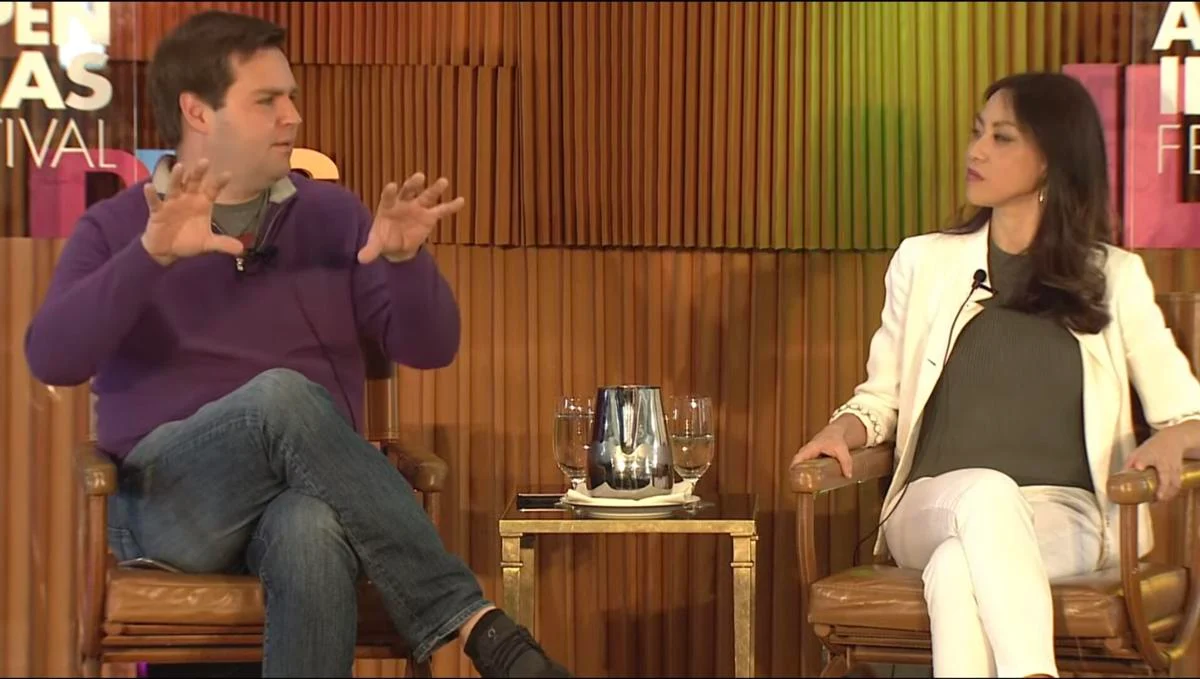
Two public appearances JD Vance made in Aspen in the 2010s offer a glimpse into the early stages of his transformation from a Never Trump conservative into a rising MAGA superstar.
Vance’s statements here were consistent with his past remarks and shifting conservative views that have been analyzed and scrutinized by political foes and the media in the three weeks since former President Donald Trump picked him to be his running mate on this year’s GOP ticket.
When he first came to Aspen in October 2016, Vance was swelling in popularity after the release of “Hillbilly Elegy,” a memoir about the struggles of growing up poor in Appalachia, that June. President Barack Obama was ending his second term and Democrat nominee Hillary Clinton and Trump were in a fierce contest for the Oval Office.
It was well before what was to come: the COVID-19 pandemic, George Floyd, the Supreme Court’s Dobbs’ decision overturning Roe v. Wade, Russia’s invasion of Ukraine and two historic turning points needing no year to identify them — Jan. 6 and Oct. 7.
Vance, an Iraq War veteran and a sharp critic of the politics and media around the invasion, was then acting as a commentator and author — he would go on to win a seat on the U.S. Senate, running in Ohio in 2021 with Trump’s endorsement.
The discussion was called “Economic Insecurity, American Values & the Politics of Resentment in the 2016 Election” and addressed the dynamics at play in the public’s growing distrust in the country’s institutions
Vance, though a conservative, was then a harsh critic of Trump but cast the candidate’s populist appeal among working-class voters as a response to the “coastal elite.”
“There is the sense among the white working class — and I don’t think it’s totally unjustified — that people who have financial, political, educational power, actually look down on the white working class in a really fundamental way. And Trump is the metaphorical middle finger to that entire movement,” he told the audience.
He prefaced those comments with a statement directly to the Aspen crowd: “There is the tunnel element of this, the sort of cultural resentment that exists in a lot of these parts of the country, which is that the sense people back home have is that the folks who are sitting in this room fundamentally look down on middle America as a bunch of dumb rednecks.”
Trump’s platform of anti-establishment, anti-immigration and anti-trade represented what Vance called a “radical departure” from the recent line of Republican presidents and candidates that included the early favorite for the 2016 GOP nomination, Jeb Bush, “and that’s what drove a lot of voters in his direction. That’s my sense of this.”
Based on his remarks then, Vance held Trump in low regard.
“My biggest problem with Trump, and there are many, many things to pick out, my biggest problem with Trump is that his message to the right, especially the white working class of which I came from, is anti-conservative and in some ways anti-American,” he said, arguing that Trump was making it sound to voters like “the deck is so stacked against you that unless I’m president, nothing that you do will change your life’s outcomes. I think it’s wrong and very self-destructive.”
At the 2018 Aspen Ideas Festival, Vance and Amy Chua, author of “Battle Hymn of the Tiger Mother,” held a public talk called “Can Americans Resist the Pull of Tribalism.” Chua was a professor of Vance’s when he was a first-year law student at Yale and encouraged him to write “Hillbilly Elegy.”
Trump was president then, and Vance told the Aspen audience that he was repelled by one of the 2016 election’s narratives that economic and racial anxieties drew voters to Trump.
“And I always thought that was a little dumb,” he said, “because it almost presumes that there are only two thoughts that people can hold in their head: Either I’m poor or I hate black people and of course, people are a lot more complicated than that.”
Clinton’s “baskets of deplorables” comment about Trump voters made at a September 2016 fundraiser did her no favors, Vance said. While he argued that the people out of touch with the so-called flyover demographic also turned off that demographic, Vance also struck a populist tone.
“When I talk to people back home, if there was a single group that they were most angry at, a single group that they were most frustrated at — it wasn’t religious or ethnic minorities; it was coastal elites,” he said. “It was the people who call the shots, the people who were on the show, the people who work on Wall Street, the people who work in Silicon Valley.
“There was this palpable sense of anger at that group — much more than any other group, and of course, you listen to President Trump’s speeches, and certainly they are tinged with criticisms of Mexican immigrants or Muslims or whatever the case may be. But like 85% of his most visceral critical comments have always been at so-called coastal elites, the people who call themselves their betters.”