
ROARING FORK BROADCASTING COMPANY



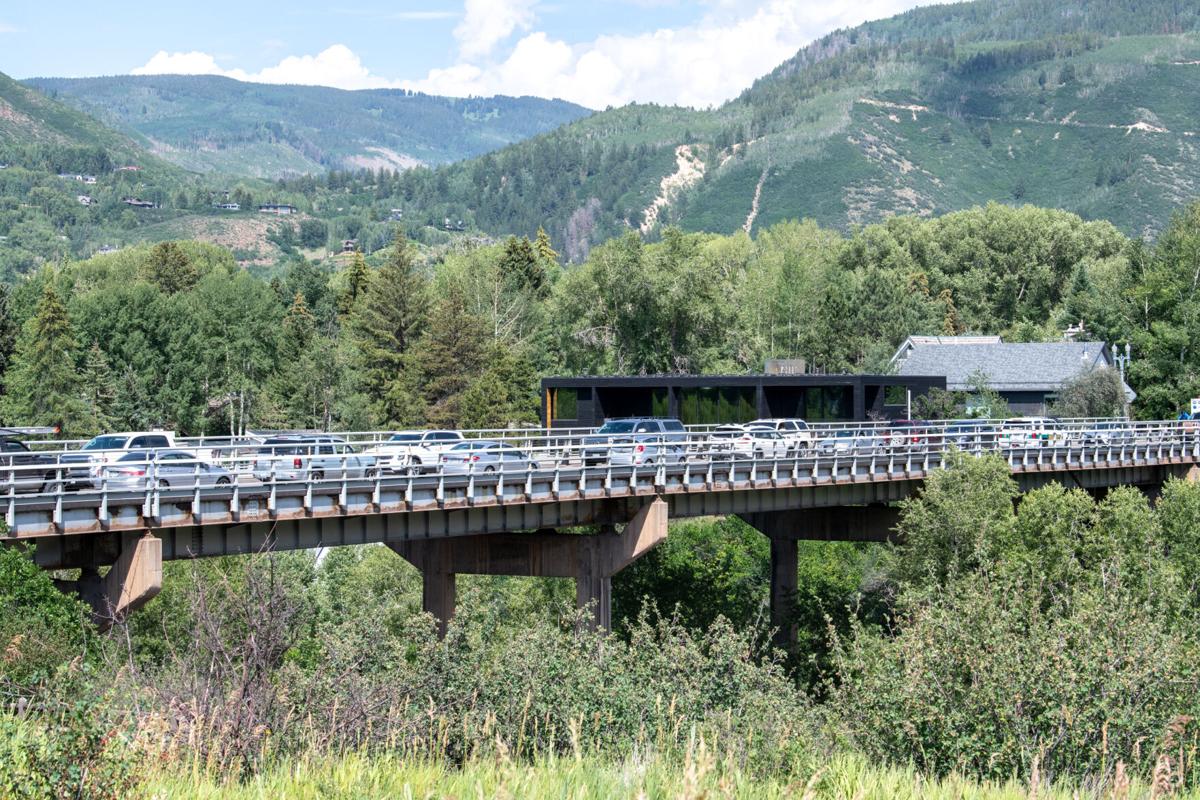
A majority of Aspen City Council members said they prefer replacing the aging Castle Creek Bridge in its existing location, rather than realigning Highway 82 across the Marolt Open Space to a new bridge, in the leadup to a Tuesday vote that could decide the city’s direction on one of its most critical pieces of infrastructure.
Council members expressed their views on bridge replacement options during a work session on Monday — the latest in a four-month stretch of meetings in which council has received three sets of consultant presentations about the deteriorating structure.
Council members are scheduled to vote on the next steps regarding bridge replacement during their regular meeting on Tuesday. The city cannot unilaterally decide how to replace the bridge — which is owned by the state and subject to federal regulations — but it can seek to open different regulatory processes that may allow for different replacement options under the National Environmental Policy Act. The city would also need a citywide vote to implement the replacement option using the Marolt Open Space, according to City Attorney Jim True.
During Monday’s work session, Mayor Torre asked council members to rank three bridge replacement options presented by consultants. Torre, Councilman Bill Guth and Councilman Sam Rose all preferred a replacement at the bridge’s existing location, ranking a “split-shot solution” second and the so-called “preferred alternative” — which would use the open space — last.
“If you’re going to pave over a beautiful field of open space, you better have as close to a perfect design as possible,” Rose said, arguing that the “preferred alternative” has too many flaws to justify its impacts on the Marolt property.
Councilmen Ward Hauenstein and John Doyle said they ranked the “preferred alternative” highest, followed by the “split-shot” and a replacement in the existing alignment.
The bridge, consultants have said, is showing multiple signs of serious deterioration, having now lasted more than a decade beyond its 50-year design life. The consultants said that if the bridge’s condition worsens much more, it could cause the Colorado Department of Transportation to intervene and strip the city of some decision-making power on the issue.
The bridge is Aspen’s primary access point during much of the year, serving as a critical route for workers who commute into the city every day from downvalley. Around 22,000 individual vehicles cross the bridge and six bus routes use the bridge each day in summer.
Global engineering firm Jacobs Engineering, which the city hired to study replacement options for the bridge, presented the three alternatives as large-scale options for replacing the bridge.
The one option currently approved under NEPA is the “preferred alternative,” which would realign Highway 82 so that it crosses the Marolt Open Space to a new bridge, after which it would meet directly with West Main Street, bypassing the S-curves and allowing for bus lanes to travel in and out of Aspen without interruption. It would keep a two-lane bridge in the existing location only as a connection between Cemetery Lane and downtown Aspen. “Preferred alternative” proponents commonly argue that it would improve transit options and provide Aspen with better evacuation routes in case of a wildfire.
“I am going to advocate for a new bridge so we have better public transit, better evacuation routes and we can use the new bridge while we replace the old one,” Doyle said.
The Colorado Department of Transportation has said it will construct the “preferred alternative” when the existing Castle Creek Bridge requires replacement. The state has said that keeping the highway on its existing alignment would require an extensive and unpredictable NEPA process meant to change the 1998 approval. Opponents of the “preferred alternative,” including an attorney hired by Friends of Marolt Park and Open Space, have argued that replacing the existing bridge with a three-lane option would not require such a complex process.
For many Aspenites, however, the “preferred alternative” is unattractive because of its impacts on the Marolt Open Space. The Aspen-based advocacy group Friends of Marolt has opposed the plan for decades, recently hiring an attorney and a media strategist to support their cause.
“(The open space) is our front yard, and I worry about putting a highway through it,” said Carbondale-based media strategist Allyn Harvey, who was hired by Friends of Marolt.
These opponents have advocated for replacing the bridge in its existing location while adding a lane. They and other Aspenites have argued that since a two-lane Castle Creek Bridge in its existing location is part of the “preferred alternative” (serving as a connection between Cemetery Lane and downtown Aspen), the city should focus immediately on restoring that bridge.
Some Aspenites have also supported a “split shot” option, which would route inbound traffic through the open space while sending outbound traffic over the existing bridge.
Twenty-five people spoke during a special public comment period at the work session (public comment is usually reserved for regular meetings). The largest contingent advocated against the “preferred alternative,” while a handful spoke out against the three-lane replacement.
At least three members of the Gregory family, who have lived almost directly beneath the Castle Creek Bridge for 38 years, spoke against the three-lane replacement, which could require the acquisition of their home.
“I grew up under the bridge,” said Haylen Gonzalez-Pita, a member of the Gregory family. “For those concerned with Marolt, I have always considered it my makeshift yard due to not having one and I would be sorry to see it changed, but I would be even more sorry if my parents lost their home of 38 years.”
Torre said he would be interested in exploring mitigation measures to keep from “unhousing” the Gregories during a three-lane replacement process.
Speakers advocating for the three-lane replacement argued that the “preferred alternative” would negatively impact residents on West Main Street between 7th and 8th streets, where the new highway alignment would enter town.
“Your engineers recently surveyed the four-lane expressway through that block, and they reported only on the loss of parking places along Main Street,” said Aspen resident Neil Siegel. “Somehow, they missed the kids, they missed the bikes lined up, the basketballs.”
No one representing the thousands of workers who use the bridge everyday spoke at the meeting, and none of the council members mentioned those people’s wellbeing as a factor in their decision.
Per a Jacobs analysis, the three-lane replacement and the “preferred alternative” would both improve rush hour travel times for general traffic and buses going in and out of Aspen, with the “preferred alternative performing slightly better (seven-minute reductions for drivers and 10 minutes for bus users versus reductions of three and 10 minutes under a three-lane replacement). Both would create more system congestion, though the “preferred alternative” also performed better here (23% congestion increase under three-lane replacement and 6% under the “preferred alternative”). These traffic modeling projections are for 2050. Jacobs estimated that both would cost roughly the same to construct ($146 million for the three-lane, $148 million for the “preferred alternative”) though their estimate for the “preferred alternative” did not include the cost of replacing the existing Castle Creek Bridge in its same location as a future connection for Cemetery Lane.
With all of the complex information and heated opinions involved, Rose said the contentious bridge debate is the “worst” issue he has dealt with during his year on council.
“Emotions are high and the idea that if someone disagrees with you, that makes them an idiot and/or evil,” Rose said. “I’m sick of this rhetoric.”