
ROARING FORK BROADCASTING COMPANY



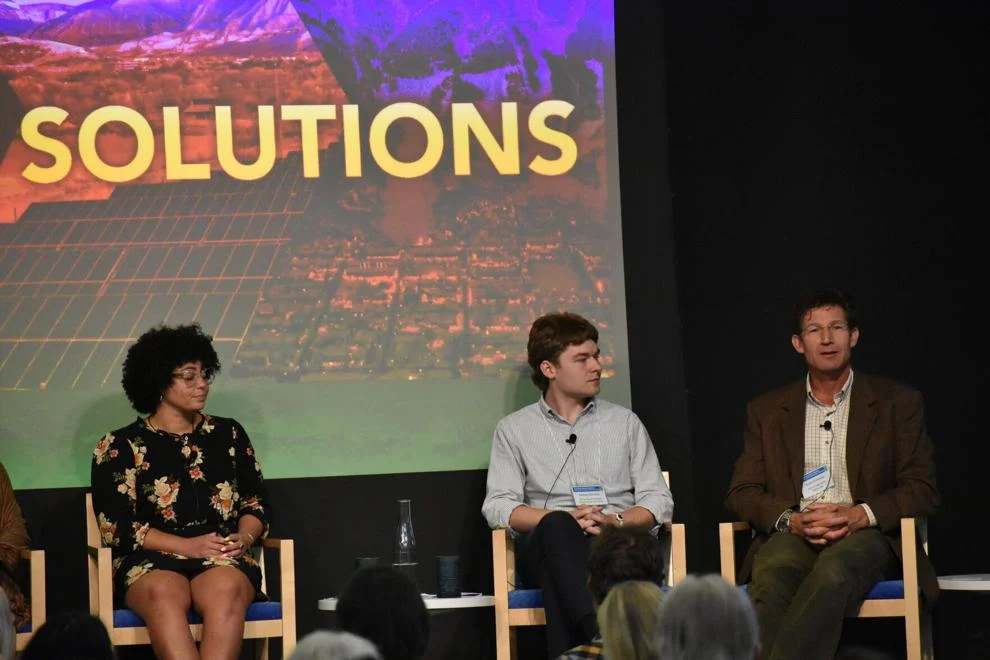
Climate experts consistently identified workforce shortages as one of the largest hurdles keeping rural communities from transitioning to renewable energy sources during a panel at the Aspen Meadows Resort on Thursday.
The four panelists said rural communities struggle to access contractors, auditors and other personnel they need to make their buildings and infrastructure greener.
“Workforce has been a bit of a theme here,” said panel moderator and former Colorado Governor Bill Ritter. “Before we can take advantage of expanded opportunities, we’re stymied by this question around workforce.”
Speakers said insufficient access to professional services and employees holds back wealthy and poor rural communities alike when they’re seeking to reduce their greenhouse gas emissions.
“In our rural valley, where we have labor problems and housing problems, if you pass an electrification code … there are only three people who can do it, if that,” said panelist Auden Schendler, Aspen Skiing Company senior vice president of sustainability.
Francesca Santos, program officer at the Rural Climate Partnership, said she sees a similar lack of expertise and services in areas without the housing affordability struggles of the Roaring Fork Valley. Santos pointed to sparsely populated Indian reservations like the Navajo Nation, where it can take hours to reach a single client by road.
“There’s no one to actually go and do the work. There are no contractors available, no one to do the home installations, no one to do the energy audits,” Santos said. “When a contractor has an opportunity to either service one client in a rural space or multiple clients in an urban center, most of the time, they’re going to choose an urban space and rural is going to miss out.”
While all rural communities seem to struggle from workforce shortages, Schendler said local governments and private companies can build ecosystems of expertise in wealthy communities like Aspen.
Meanwhile, Santos said years of consistent advocacy at the state level and grassroots collaboration in rural communities are often necessary to bring climate solutions to poorer rural areas.
The panel, titled “Resilience: The unique opportunities and challenges of Rural, resort and energy transition communities,” was part of the Energizing Climate Solutions forum, a day-long series of talks on tackling climate change in non-urban communities. The forum was hosted by the Carbondale-based nonprofit Clean Energy Economy for the Region, known as CLEER.
Throughout the panel, speakers noted the social and political difficulties of applying big, complicated solutions in small communities.
For expensive resort communities, housing is at the crux of those solutions, Schendler argued. Housing workers far from their jobs and forcing long commutes, he said, creates additional greenhouse gas emissions, worsens quality of life for workers and increases congestion in communities along transportation corridors.
“Just one story — the story of housing — integrates almost everything you need to address on climate: transportation … the built environment and the utility sector,” Schendler said.
Schendler argued that Roaring Fork Valley elected officials can be hesitant to build the infrastructure necessary to house workers closer to their jobs or reduce emissions for the sake of nostalgia and community aesthetics.
“When we try to build housing in the mid-valley, we encounter NIMBYism,” Schendler said. “Communities really don’t get modern smart growth planning, and the way you win an election here is ‘freeze the community in time’ and protect it, but as Aspen and others have shown, you destroy it. It’s going to change, so how do you want it to change?”
One audience member asked Schendler on Thursday how he would respond to the argument that the construction of new affordable housing and infrastructure would produce more emissions than they would save (construction itself has associated greenhouse gas emissions).
Schendler said the growth impacts of workers living downvalley would take place anyway but in a different location, adding that new electrified buildings with a renewable power supply will be clean.
Schendler also pointed back to the quality of life improvement for working people when they can live closer to where they work.
“(Workers) are going to live somewhere. So they’re either living in Rifle or further and commuting, or they’re living near where their work is and having a better quality of life,” Schendler said.
Despite debates over some major housing projects and infrastructure, the Roaring Fork Valley has charged ahead with ambitious affordable housing projects and green infrastructure goals.
The city of Aspen’s envisioned Lumberyard affordable housing development, which will contain between 277 and 304 units, will be 100% electric. The development will have a solar array on the roof and is expected to offset 75% of its energy use.
Aspen passed some of the strictest building codes in the state last year, designed to reduce emissions associated with structures. The city is contemplating further requirements for electrification of homes and new buildings, though that move has been controversial among some Aspen residents and city council members.
The broader Roaring Fork Valley’s electric supply is largely renewable. Utilities for the cities of Glenwood Springs and Aspen both rely entirely on renewable sources while the Glenwood Springs-based power Holy Cross Energy cooperative reached 76% renewable energy mix in March. Holy Cross covers the entire towns of Snowmass Village and Basalt, as well as large portions of Aspen and Carbondale and unincorporated stretches of the Roaring Fork Valley.
Local officials have advocated for these changes as scientists say the impacts of climate change become more apparent in Colorado. Scientists have noted more frequent and more intense droughts, fires and heatwaves in the state during the last twenty years.
During introductory remarks before the panel on Thursday, Aspen Mayor Torre pointed out that climate change has brought noticeable changes to the Roaring Fork Valley.
“We have one month less of winter and cold temperatures, and we’re seeing that play out in the way pine beetles and bark beetles are impacting our forests,” Torre said.
Up the Castle Creek Valley, gray clusters of beetle-infested fir trees overlooked the Meadows Resort from Aspen Mountain.
By the end of this year, the USDA expects to have given out around $11 billion for rural clean energy projects, largely with funding from the Inflation Reduction Act of 2022. Nonetheless, local and national experts in rural economic development said it’s a struggle for rural communities to access those funds during Thursday’s panel.
“The capacity that it takes to apply for these federal grants, I mean I’m tired just thinking about it,” Santos said. “It’s really challenging, and most rural places and rural organizations don’t have the capacity needed.”
Santos argued that climate solutions should be more accessible to the rural areas considering their outsized emissions production. The Rural Climate Partnership has found that 36% of US emissions are produced in rural areas while 18% of the country’s population lives in those same areas, according to a report released in May.
Even when individual states make funding available for climate solutions that might help rural communities, Santos argued, the communities with the most need often struggle to reach them.
At the end of the panel, Colorado River Valley Economic Development Partnership Director and Rifle City Councilwoman Alicia Gresley raised her hand to ask a question from the audience.
“There is a lot of money out there right now. Grants are talked about a lot. ‘Rural’ is a buzzword right now,” Gresley said. “The reality is that we don’t have the capacity to fight for these grants.”
Gresley did not clarify if she was speaking in her capacity at CRVEDP or on Rifle City Council. CRVEDP is a collaborative between Colorado River Valley municipalities (New Castle, Silt, Rifle, Battlement Mesa and Parachute) that works to stimulate local economic growth in their shared region.