
ROARING FORK BROADCASTING COMPANY



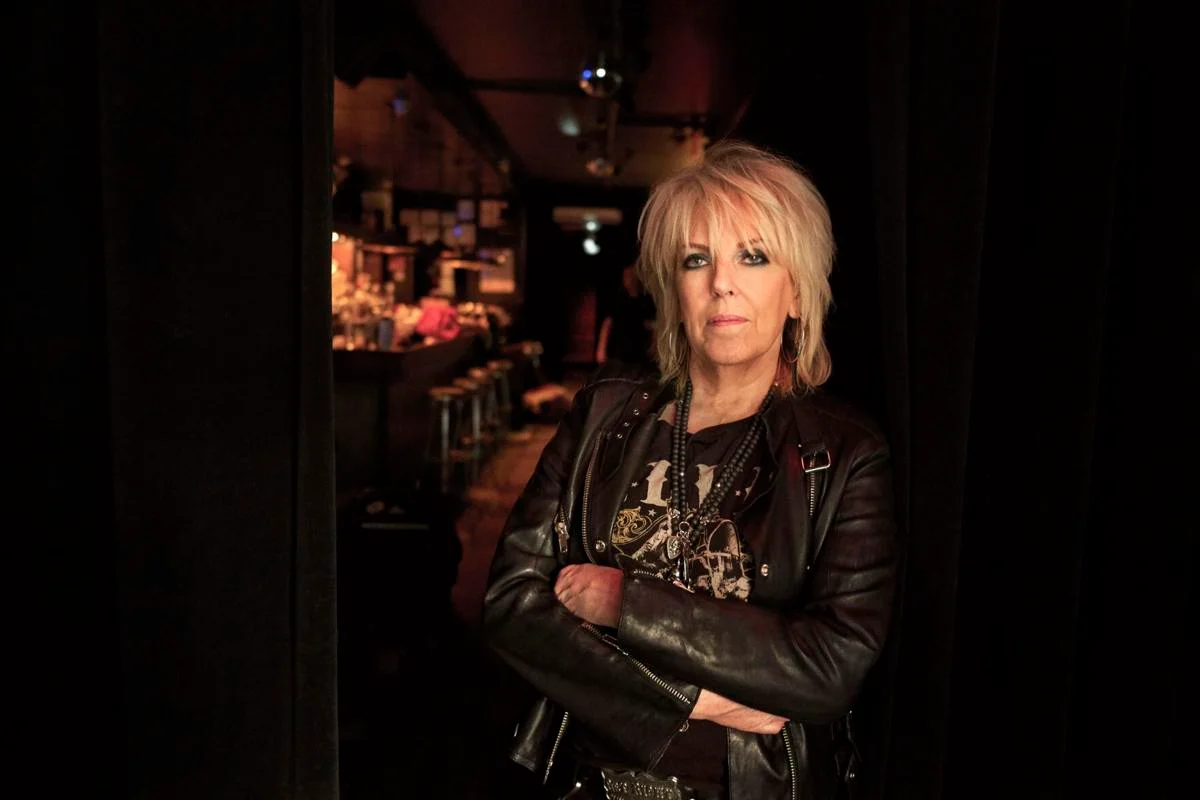
In 2002, Time magazine called Lucinda Williams “America’s greatest songwriter.”
If you wanted to look for a male songwriter of a similar stature, John Prine might be a good choice. Not everyone is familiar with Williams or Prine — they aren’t everyday names. But if you know, you know.
If you had to back up Time’s claim with a song that captures her acumen as a songwriter, you might throw the title track from her 2011 album, “Blessed,” into the ring.
In the song, Williams writes about a series of characters whose sacrifices and sufferings yield blessings for the rest of humanity. It is as powerful a song about gratitude as there is, a series of paradoxes with imagery as profound as it is poetic.
“We were blessed by the neglected child, who knew how to forgive. We were blessed by the warrior who didn't need to win. We were blessed by the prisoner who knew how to be free. We were blessed by the homeless man who showed us the way home. We were blessed by the little innocent baby who taught us the truth. We were blessed by the forlorn, forsaken and abused. We were blessed. Yeah, we were blessed.”
On Nov. 17, 2020, at the age of 67, Williams suffered stroke on the right side of her brain which impaired function on the left side of her body. She has spent the last four years rehabilitating — relearning how to speak, walk, write and sing.
When asked, “After all you’ve been through, do you still feel blessed?”
“Yeah, I still do,” Williams, 71, said in a recent phone interview from her home in Nashville. “Sometimes I have to stop and think about it, you know, but I have to remind myself that I'm blessed. I’m still in recovery; I mean it’s been a long, slow process, but it’s gotten better. I’m not all the way 100% back to where I was before, but I’ll be in Aspen next Sunday, so I feel pretty blessed.”
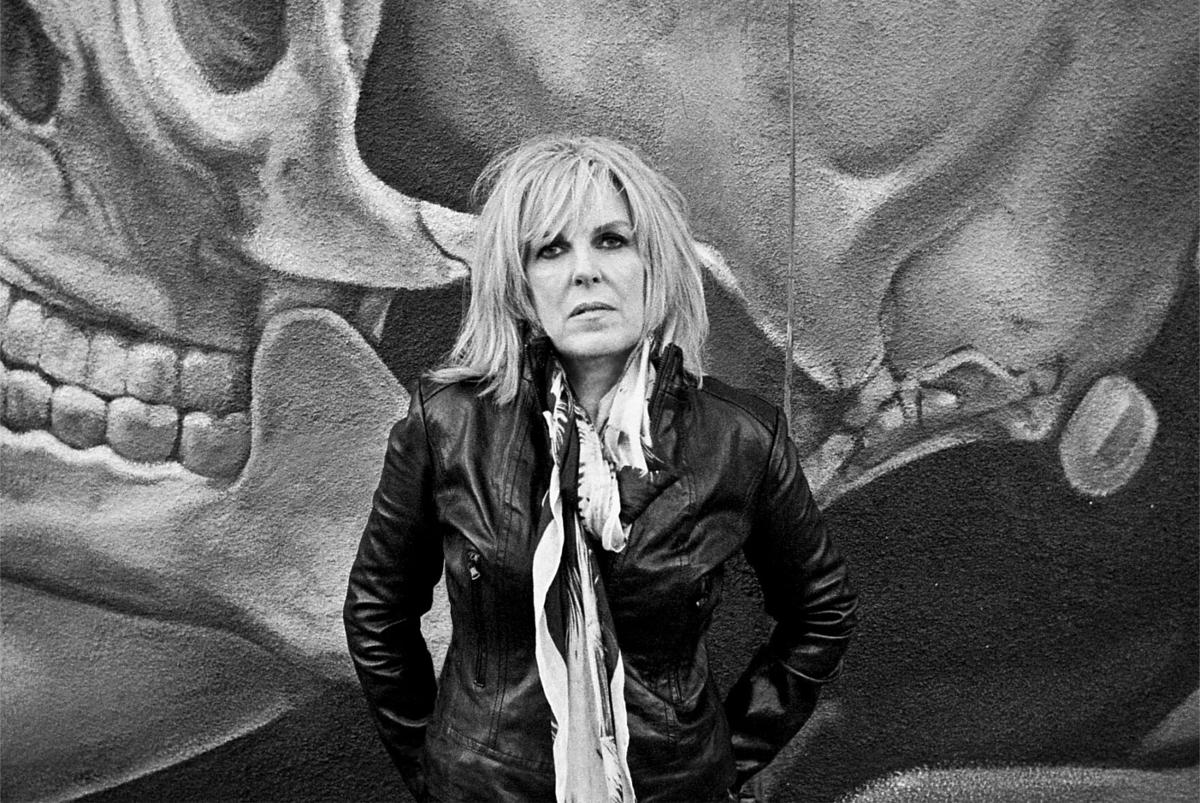
Lucinda Williams' music was once called “too country for rock and too rock for country.” When asked if she identifies as country or rock, she responded, “Definitely rock ’n’ roll.” She will bring that attitude to Belly Up Aspen on Sept. 15.
Photo by Michael Wilson
Williams was at her home in Nashville that November day when she began to feel dizzy. She had been very tired and needed to lay down. Her husband, Tom Overby, called 911 and soon she was in an ambulance on the way to the hospital.
“I didn’t honestly know what a stroke was,” Williams said. “I heard about people having strokes but thought they happened to older people. I was in the ambulance and I saw the words “Stroke Alert” on a screen and when I saw Tom at the hospital, I looked at him and said, ‘I had a stroke’ but I had no idea how serious it was. I didn't know you could die from a stroke and everyone was running around and freaking out.
“Another blessing was that I was able to go to the Vanderbilt University Medical Center which is a great hospital and you know the doctors were all really great, and the nursing staff went above and beyond the call of duty and all that. They gave Tom a cot to sleep on so he could be with me there. When they brought me my meals, they would bring him a meal.”
She spent a week in intensive care and stayed in the hospital for a month of rehabilitation before returning home to begin the long road back to recovery, which continues to this day.
Williams found support in two other people in the music business who also had strokes, SiriusXM “Deep Tracks” DJ Meg Griffin, and musician Jesse Malin from the band D Generation and a solo recording artist who has worked with everyone from Ryan Adams, to Billy Joe Armstrong to Bruce Springsteen. Williams produced Malin’s 2019 album “Sunset Kids.” He had a spinal stroke and Griffin had both an aneurysm and a stroke. The three shared their experiences.
“Meg talked about post-stroke fatigue which I’d been experiencing and couldn’t figure out what was going on because I was so tired all the time,” Williams said. I didn't know there was a name for it. That was helpful to understand what was going on.”
When asked what was the worst thing about the stroke, she said, “I can’t play the guitar anymore. It’s by far the worst part of what came out of all this, not being able to play the guitar — it’s horrible.”
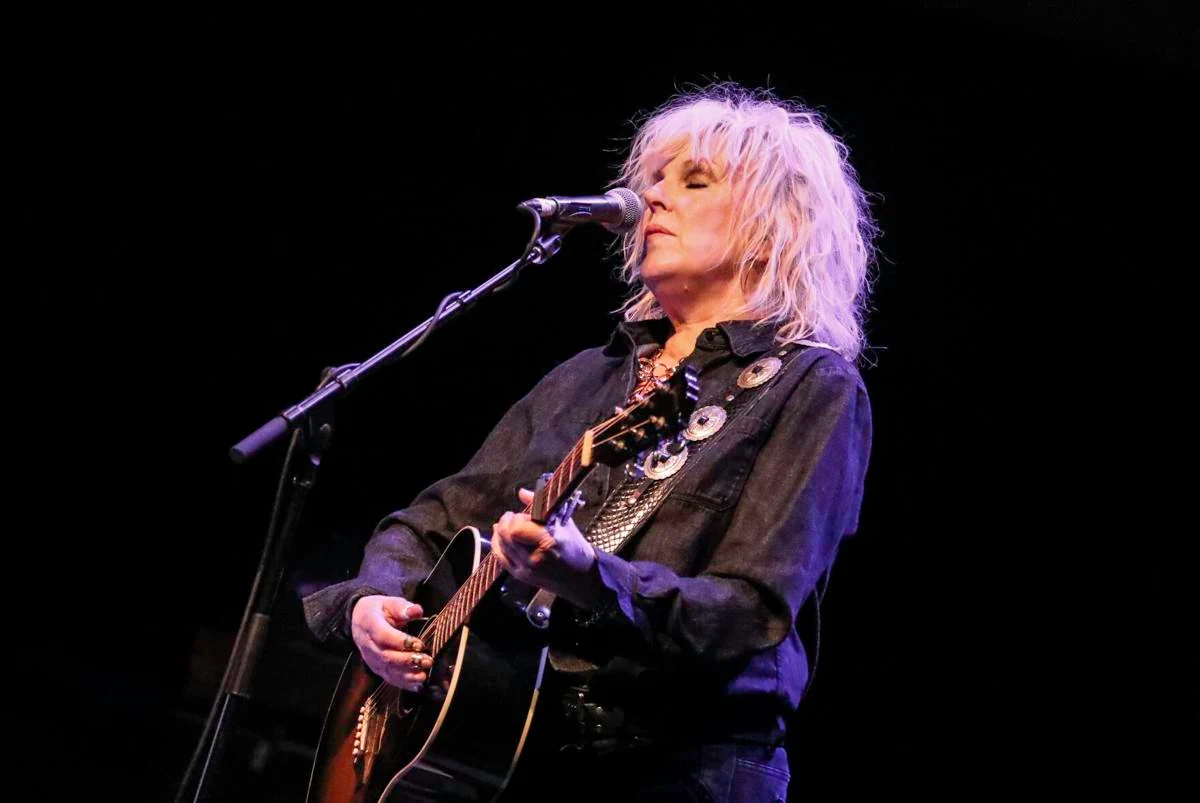
Lucinda Williams sings and plays guitar at the Fitzgerald Theatre in St. Paul, Minnesota, in 2019. She recently suffered a stroke, which has rendered her unable to play guitar.
Courtesy of Wikimedia Commons
Williams was born in Lake Charles, Louisiana. Her father is the poet Miller Williams, one of the foremost American poets of the post-World War II era.The family moved around throughout her childhood as Miller moved from university to university. When Williams was 12, her dad was teaching at Louisiana State University at Baton Rouge.
“A writer friend of my dad’s left his guitar at our house,” Williams recalled. “I picked it up and I was just really interested in it. My dad could see me being drawn to it so he suggested guitar lessons. A student of my dad’s would come over to the house once a week and give me guitar lessons. He was a creative writing student at LSU. He had a rock band on the side and then he was teaching guitar. He taught me how to finger pick and my interest in it grew and grew and so did my interest in music.”
Miller loved country and jazz, and music was played often on the turntable.
“Some of it was my dad bringing albums home himself,” Williams said. “He loved jazz and country and blues and I ended up loving that same kind of music. But most of all, he liked country music — Hank Williams, Chet Baker, Tammy Wynette — and in jazz, John Coltrane was his favorite.”
When it came to playing guitar and singing, Williams was caught up in the folk movement of the early 1960s. She was exploring the music of artists like Bob Dylan, Gordon Lightfoot, Leonard Cohen and Donovan.
One day her teacher came over with a new album, a 12-inch musical zeitgeist in the form of Bob Dylan’s “Highway 61 Revisited.” The opening track, “Like a Rolling Stone,” captured the vibration of a generation — “How does it feel/to be on your own/a complete unknown/like a rolling stone?” In Rolling Stone’s 500 Greatest Rock Songs of all time, the song (which begat the name of the magazine) clocks in at No. 1.
“I was just blown away by that record,” Williams said. “When Dylan made a record it was happening, but nobody was prepared for that record — the music itself, the album cover, this lanky guy wearing jeans and a Triumph motorcycle t-shirt. He's got this soft, wavy hair. I was smitten.”
Williams went to college in New Orleans and by then she was listening to everything from music from Laurel Canyon, like Buffalo Springfield and The Byrds, to British rock, like The Rolling Stones and Cream, to other U.S. artists like Jimi Hendrix, Janis Joplin and Jefferson Airplane.
“I was also hearing female artists I identified with,” Williams said. “Grace Slick from Jefferson Airplane was definitely one of them. I was also falling in love with a good song. It was just an amazing time to be alive for music.”
Williams went to college at The University of Arkansas (where her father was teaching). In 1974, she moved to Austin. By this time, Williams was writing songs and performing them acoustically.
Austin was one of the first cities where the singer-songwriter genre thrived. Artists like Jerry Jeff Walker, Butch Hancock, Jimmy Dale Gilmore, Rodney Crowell, Guy Clark and Townes Van Zandt were all playing frequently.
“I cut my teeth in Austin,” Williams said. “You could find places to go play where the audience would listen to songs. It was a songwriting town. They celebrated the idea of songs. So it was a really good place to be at that time.”
By the end of the decade, Williams was ready to cut her first record. She made a demo and shopped it around to different labels. “Sony Records in Nashville said it was too rock for country, and Sony in Los Angeles said it was too country for rock,” she said.
Williams eventually teamed up with the Folkways Label and released her first album, "Ramblin,” in 1979. In the 45 years since, Williams has oscillated between the worlds of country and rock ’n’ roll, which is the space occupied by the “Americana” genre. There, Williams is regarded as a legend.
She has released 22 albums over the course of her career and is regarded by many as an American treasure. Some highlights include her third album, “Lucinda Williams” (1988), which featured her breakout song, “Passionate Kisses,” later recorded by Mary Chapin Carpenter on the album “Come on Come on.” Carpenter’s cover version earned Williams her first Grammy for Best Country Song in 1994.
Her 1998 album, “Car Wheels on a Gravel Road,” is considered a masterpiece. It is universally hailed as one of the greatest albums of the 1990s and Rolling Stone ranked it No. 98 in its 500 Greatest Albums of All Time. It was certified Gold by the RIAA and earned her a Grammy for Best Contemporary Folk Album.
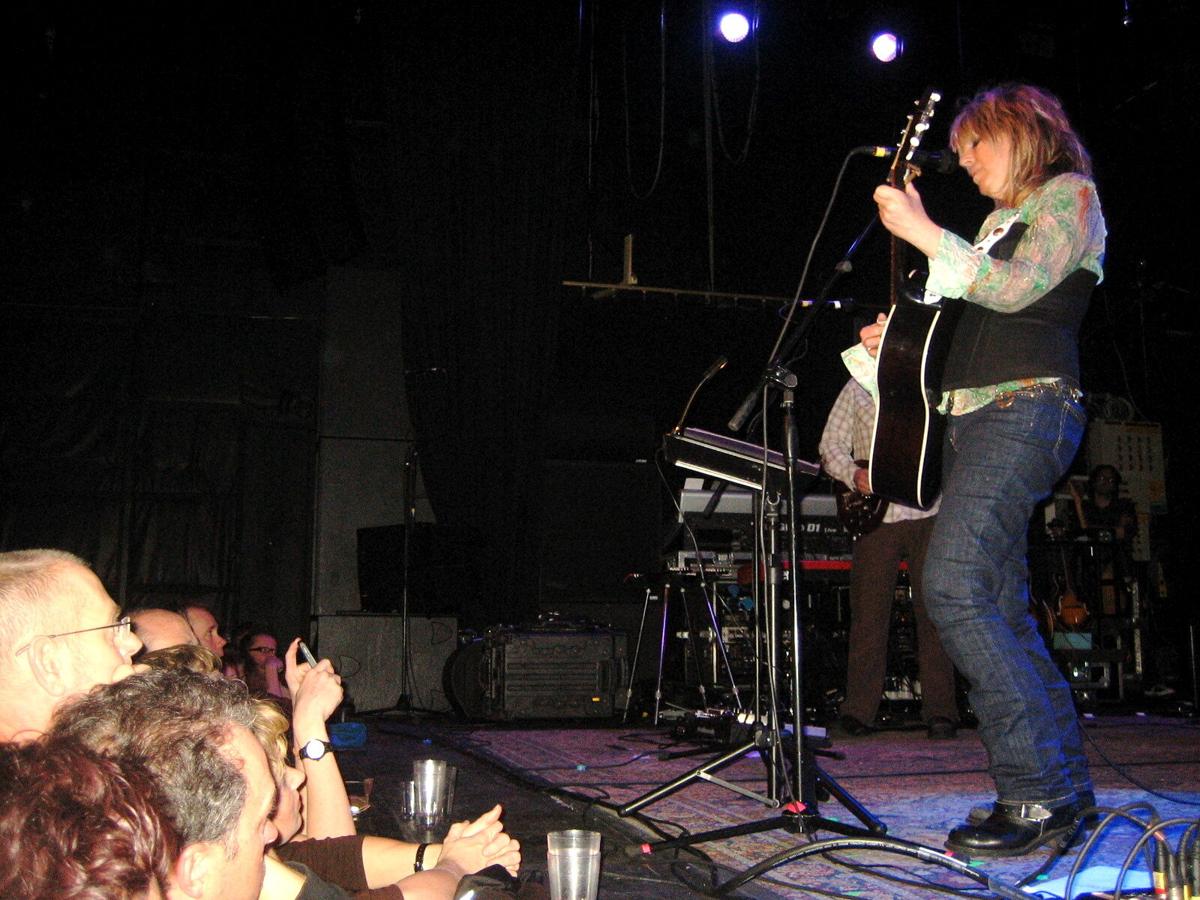
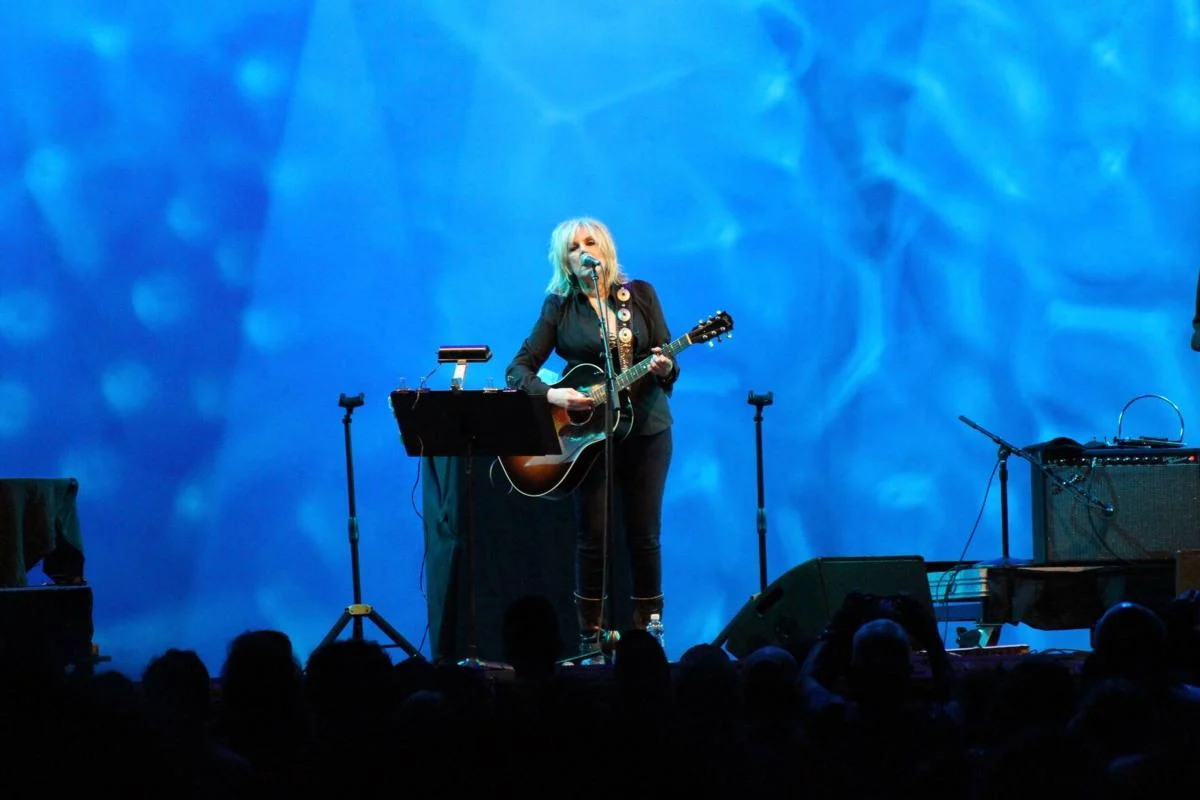
Lucinda Williams plays before an enthusiastic crowd during a 2007 show in The Netherlands. Living in Austin, Texas, in the 1970s, she cut her songwriting teeth. “You could find places to go play where the audience would listen to songs. It was a songwriting town.”
Courtesy of Wikimedia Commons
Williams’ next album, “Essence,” arrived in 2001 to further critical acclaim and commercial success, becoming her first Top 40 album on the Billboard 200, peaking at No. 28. It featured more spare, intimate arrangements. “Essence” earned Williams three Grammy nominations and won for Best Female Rock Vocal Performance for “Get Right with God.”
And if you want to hear perhaps the sexiest song ever written from a woman’s perspective, give the song “Righteously” a spin from 2003’s “World Without Tears.”
Without a doubt, the most difficult album to make was her most recent album, 2024’s “Stories from a Rock ’n’ Roll Heart,” the album she made following her stroke.
“Writing songs was always part of my rehabilitation,”Williams said. “I wasn’t going to sit around and not do anything. But it’s hard to write a song without an instrument. My process has always been to come up with some lyrics, then get the guitar and come up with a melody and some kind of structure.”
The post-stroke songwriting process became collaborative and Williams was surprised at who became her main writing partner — her husband, Tom Overby.
“Tom had never really written any songs,” Williams said. “I would be working on a song, and Tom would come up and say, ‘I wrote these lyrics down and you don’t have to use them or anything but I just wanted to show them to you and see what you thought.’ And I would read them and you know, they were really good. Wow! What a surprise! And so I would use the lyrics in what I was working on or start a whole new song with them. And it has been as rewarding as writing a song on my own.”
Williams also brought in her collaborator and fellow stroke victim Jesse Malin. Her tour manager, Travis Stevens, also is a gifted songwriter and guitar player. He was staying in the house to help Williams out and he would lend a hand with his guitar to help work out melodies. Finally, the guitar player in her band, Doug Pettibone, also helped by adding guitar to the songs.
“I really feel like we have some great songs on the new record,” Williams said. “The song ‘Where the Song will Find Me’ best sums up the spirit of the album. I wanna feel that moment when the song can find me. I wanna feel that moment when the song can save me.”
“It’s frustrating I can’t play the guitar, but I’m lucky I have these friends to work with me,” Williams said. “I’m grateful I can still write songs and sing. That’s a huge blessing.”