
ROARING FORK BROADCASTING COMPANY



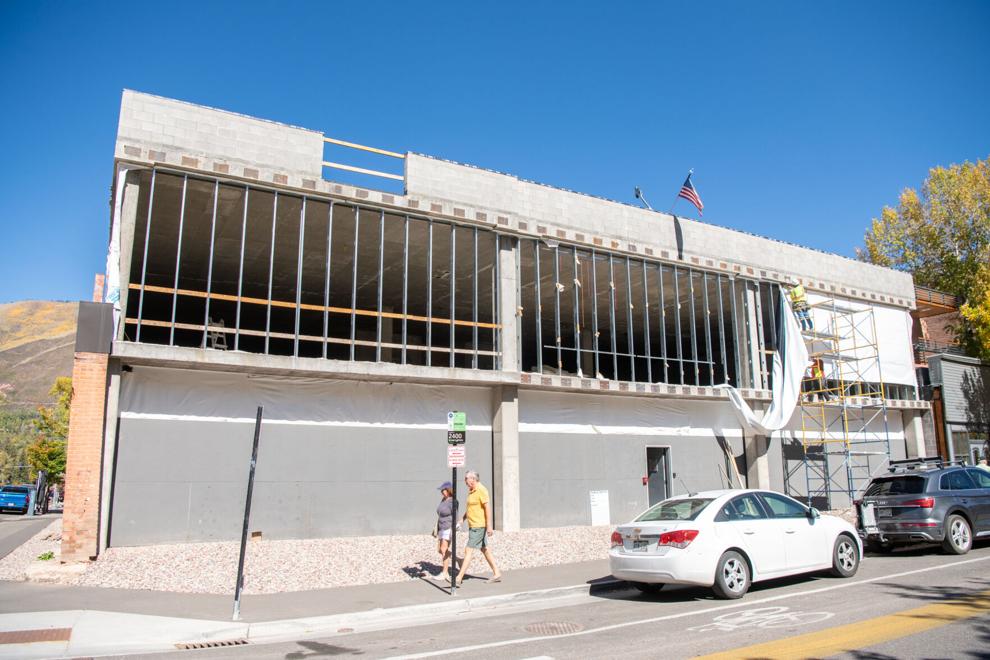
A special meeting held this week by the Aspen Historic Preservation Commission spotlighted the debate over the preservation of buildings and the community’s frustration over a hotel project construction moving at a seemingly glacial pace — and that doing business during the High Holy Days can leave out key decision-makers.
The High Holy Day in this instance is Rosh Hashanah, the Jewish new year that began at sundown Wednesday and concluded at sundown Friday.
Wednesday’s HPC meeting, which started at 4:30 p.m., was not part of the HPC’s regular calendar. It was scheduled in response to a request introduced the first week of August from the project team building the RH Guesthouse on the Crystal Palace site, located at the corner of East Hyman Avenue and Monarch Street.
As an application for a substantial amendment review, the request asked the HPC to allow the developer — Aspen commercial landlord Mark Hunt and M Development, who is working in tandem with California-based RH (formerly Restoration Hardware) — to make significant changes to HPC approvals granted in 2017. The project received a core and shell permit in 2019. The entire building’s structural framing, which includes the third story, is complete.
Not attending the meeting was HPC member Jodi Surfas, who told the board at a September meeting that she would be observing Erev Rosh Hashanah, which is the eve of the Jewish new year.
Surfas is a member of one of three Jewish congregations in Aspen. HPC alternate Riley Warwick was appointed to fill in for Surfas in order to meet the requirement of a minimum seven-member voting quorum.
arwick cast one of the four votes by HPC members supporting the application, effectively allowing for the demolition and reconstruction of the building’s west wall. That will involve replicating the Owl Cigar mural and relocating it from its corner spot to the rebuilt wall’s center area. Additionally, the approval allows for some architectural revisions and reconfigured window openings.
The decision was final, though it will not be official until a resolution reflecting the outcome gets formal approval from HPC. Aspen City Council also reserves the right to call up the decision and remand it with directions to the HPC.
Board member asked for different date in September.
At the HPC’s Sept. 11 meeting, Surfas expressed dismay that the special meeting date landed on Oct. 2. She said the meeting was a “big deal” that she wanted to attend, but her religion came first.
“I will not be at the next meeting, which is in two weeks, which is Erev Rosh Hashanah, which is basically the biggest holiday in the Jewish calendar,” she said. “Why can’t we do it not on a Jewish holiday?”
Ben Anderson, the city’s director of community development, said the date was chosen due to limited calendar options and to accommodate a project with expiring building permits.
Oct. 1 would not work because Aspen City Council was meeting on that date. Sept. 30 would be too ambitious for a city staff to compile all of the information for the special meeting. Additionally, Anderson said the HPC was not bound to that date and could reschedule the hearing, though the team for the RH Guesthouse project was told the special meeting would be held on the first Wednesday of October.
“Obviously it’s a project with high community interest,” Anderson said at the Sept. 11 meeting. “The application sort of came in and I think, due to some absences and planned vacation with some (HPC) members, this special meeting was requested … We’ve got building permits that are expiring, we’ve got lots of (Aspen City Council) interest in this project, and I think we’re getting to a point where they have landed on a proposal to get things moving, and I’m trying to accommodate that.”
Getting the project’s architects in the same room on the same date also made Oct. 2 doable, said Anderson, who noted that his staff “cannot turn around on a really complicated request. In fact, Oct. 2 was pressing the issue for us. We’re trying to do our best to meet a bunch of needs, which is how we landed on the second.”
HPC member Barb Pitchford said it wasn’t the board’s duty to accommodate the developer’s deadlines and urgencies.
“That’s the applicant’s problem, that’s not our problem,” she said.
The frustration voiced by Surfas at the September meeting carried over to Wednesday’s HPC proceedings.
“It’s not typical to have a meeting held on Rosh Hashanah,” said Natalie Feinberg Lopez, a former historic preservation officer for the city, during the portion of the meeting allowing comments from the public. “You are missing a member of the board because of that. I want to say that usually by the state of Colorado, for historic preservation anyway, all voices on these boards are considered equal, even though people are architects or designers or something else, so the fact that it is tonight makes one person’s voice less equal than the others’, which is a big disappointment.”
Feinberg Lopez said that “holding a meeting tonight means there’s a whole group of the community who’s not able to be part of if they wanted to … by holding that tonight you have essentially limited a group of people’s First Amendment right and their rights to freedom of religion, that makes them second-class citizens in the city.”
Board chair Kara Thompson responded that the HPC would not repeat similar scheduling conflicts in the future.
“We’ve discussed this several times as a board and moving forward, this will not happen,” she said, adding “the comment is heard.”
Community members observing Rosh Hashanah were allowed to speak early in the meeting, before Hunt spoke and his group spoke to the HPC.
Prefacing his remarks about the application being considered, Hunt expressed empathy for the timing of the meeting.
“I, too, think it’s unfortunate that the date fell where it fell,” he said. “To our community, happy and healthy new year, my family included. For people who don’t know this, this has been a long time coming, and we’ve been working a very long time to sit in front of this board.
“We’ve been wanting to come to this board as things as unveiled as we were looking to redevelop what once was the Crystal Palace.”
Scheduling to accommodate all faiths is tricky in a country as diverse as the United States, said Aspen Jewish Congregation Rabbi Shira Stutman on Friday. Stutman is not involved with the HPC or the hotel development.
“I recognize that almost all the time when events are scheduled on or close to our important holidays, it’s not intentional,” she said. “However, there is a relatively large Jewish community in Aspen, so it would be lovely that some of the most important meetings can be scheduled with our holidays in mind.”
At Wednesday's meeting, HPC member Roger Moyer echoed what Surfas said at the September discussion.
“I do think it’s really too bad that we’ve ignored a holiday. If it were Christmas Eve, would we all be here?” he said.
Ultimately, the HPC went against Anderson’s advice to take the matter under consideration and not take a vote until a later date. Anderson offered alternatives to the proposal that he said would respect but not compromise the building’s historic value as the community sees it.
Builders and architects said the building’s west wall has stalled the project because it is structurally unsound. The west wall is now the last remaining portion of the 300 E. Hyman Avenue building with historic significance. The mural’s historic significance came into question as construction activities revealed materials that were not part of the original structure built in 1891. Also discovered was the mural was repainted in the 1970s to match the original one from 1908. The discoveries came after the HPC approvals were issued.
HPC members Peter Fornell, Kim Raymond, Dakota Severe and Warwick voted in approval of the application; Moyer, Pitchford and Thompson cast dissenting votes.
The RH Guesthouse will have 20 guestrooms, an RH Bath House and Spa and a restaurant, cafe and rooftop terrace. The hotel rooms will average 449 square feet in size, and conditions of approval require a minimum occupancy of two guests per room. The newest approvals do not change the building’s footprint, size or height.
The building was opened by Mead Metcalf as the Crystal Palace dinner theater building in 1958, remaining there until 2008. The original Crystal Palace opened in 1957 in the Motherlode building next door on East Hyman Avenue.