
ROARING FORK BROADCASTING COMPANY



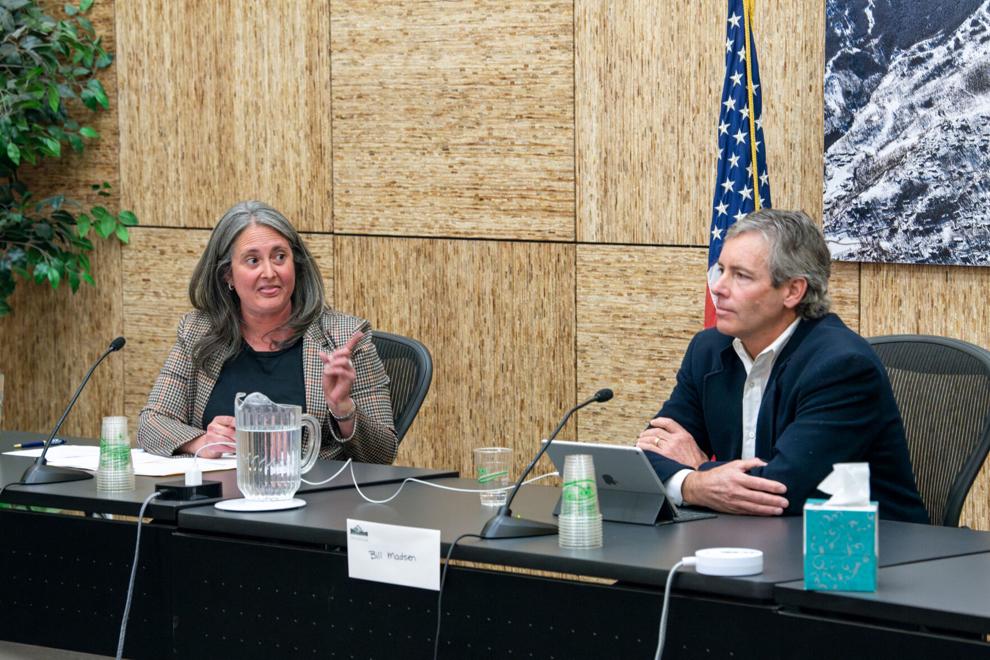
Much has been made about the similar voting track record between Snowmass Village mayoral candidates Alyssa Shenk and Bill Madsen, but the respective challenger and incumbent drew some lines in the sand at Squirm Night at Snowmass Town Hall on Wednesday.
The two showed their similarities by expressing opposition to ballot question 200 (a citizen-initiated question seeking to amend the Pitkin County Home Rule Charter by requiring voter approval for major expansions or relocations of the Aspen-Pitkin County Airport runway) and support for ballot questions 1A (increasing property taxes in the county for affordable housing projects), 1C (reaffirming Pitkin County’s control of the airport) and 2D (funding for the Draw site proposed housing development). However, Shenk started the differentiation by stating that she supports the question because it secures funding, but noted she has questions about the makeup and density of the project; Madsen supports the question and the project as it stands.
“I personally feel that, yes, it is so important to the fabric of our community and so many of my friends live in housing and it is an amazing resource that we can give people an opportunity,” Shenk said. “But I’ve listened to (Aspen Skiing Co.) and one of the things they talk about a lot is this idea that you don’t want to just put housing somewhere for housing’s sake. You’ve got to be really thoughtful about where you’re putting it, and we have heard that loud and clear.”
Madsen, meanwhile, said that he understands the concern about density, but noted that travel along Highway 82 and keeping the town’s workers involved in the community was of utmost importance. He also alluded to the town’s workforce housing study and master plan as in support of the current Draw site vision.
“It’s important to have collaboration and make sure that we understand the community’s needs and desires, but from our workforce housing study, our master plan, the Draw site is the right place and now is the time to move forward with it,” Madsen said.
They also showed divergence on the Snowmass Mall: Shenk said the town’s comprehensive plan says that the mall “needs some love,” while Madsen isn’t “entirely convinced that the mall needs to be rehabilitated.”
Their views also veered somewhat in regard to the Snowmass Mall transit depots. Madsen said he’s wary of a large-scale facility because of the estimated 40 months it would take to complete, noting he isn’t “ready to put our mall businesses in a position where they’re going to be inconvenienced and disrupted for three and a half years.”
“I’m just really concerned about disrupting our mall businesses and just having that much construction going on at the front of our mall,” Madsen added. “That’s the entryway to our town and to be under construction for three and a half years is just not acceptable.”
Shenk countered that the current safety concerns warrant moving forward with redevelopment.

“It may seem intuitive to all the people in this room and other people watching, but it’s not to visitors,” Shenk said. “It’s not friendly to people that have disabilities. It is icy, it can be scary crossing in front of buses. … I think it’s really important to get to that point where we can get a project that goes.”
The most notable difference between the two came not at Squirm Night but at the council’s regular meeting two days earlier — spilling into Wednesday. Madsen accused Shenk and Councilman Tom Fridstein of “playing politics” when they both — along with the council’s other two members, Britta Gustafson and Susan Marolt — expressed they would not support a resolution supporting ballot question 1C during the meeting, leading to a proposed resolution’s withdrawal. Madsen asserted that Shenk and Fridstein had told him prior to the meeting that they would support the resolution. Shenk said she offered no assurances.
“When we got in the council chambers they decided to play politics and not support the resolution,” Madsen said. “That was for me one of the most challenging times as I’ve sat on this council. It was a clear opportunity for them to take a jab at me and I take it personally. So I thought it was really unfortunate and really sad that our small-town politics had come to that.”
Shenk said the council members had informed him following an Oct. 14 meeting that they were not prepared to support a resolution. During Monday’s meeting, Shenk and other council members expressed concerns that passing a resolution of support would signal a unified message across the community, when conversations with constituents had shown more diversity, even if their personal feelings supported 1C (as Shenk affirmed during Squirm Night).
She used the discussion to anchor one of her points of difference from Madsen.
“I can’t know everything and I won’t claim to know everything, so leaning on community members, leaning on people who might know more than I do and having conversations and welcoming those ideas, I think, definitely differentiates us,” Shenk said. “Also, how we prepare for meetings, the time we put into it. For me, I spend a lot of time doing homework, asking questions of community.”
For his part, Madsen said that his reelection would allow him to continue the work of two previous terms, citing improved trail systems, making the town more walkable, bikeable and liveable and focusing on environmental concerns.
“I don’t think it would be different. It would be a continuation of what I’ve worked really hard on,” Madsen said. “I want to continue to focus on how we can make Snowmass Village greener and more accessible for people. So I don’t think you would see anything change, but I think my vision has been reinvigorated because I think these are really important topics that we need to continue to address.”
Starting with the Draw site ballot question, whoever comes out on top in the mayoral race will have some dissension in the council.
Three of the four candidates for the town council’s two available seats expressed opposition to ballot question 2D, with only Art Burrows explicitly expressing support for it.
“I do support it,” Burrows said. “The reason is that we are far behind in our availability of affordable housing and we need to solve the problem soon. When I first came here many years ago I lived in employee housing, which allowed me to develop my business and become successful and buy free market. I want to give that same opportunity to other people.”
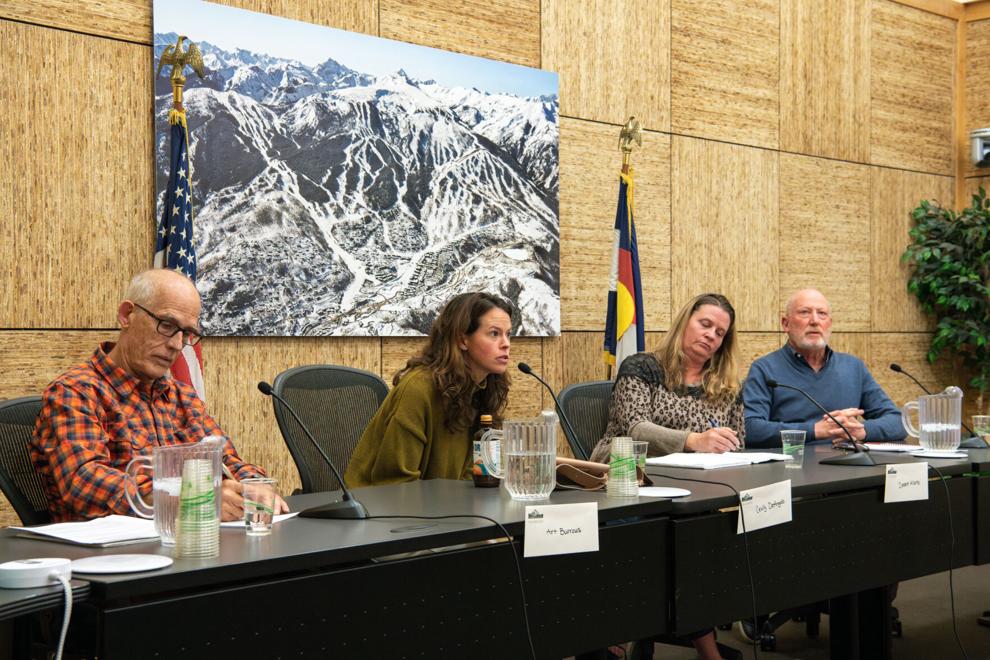
Incumbent Tom Fridstein said he supports building something “appropriate” on the site but called the current proposal deeply flawed. Debbie Alcorta said she supports workforce/employee housing, “but at this time I do not support spending $86 million.” Cecily DeAngelo also said she’s in favor of building on the spot, but believes the project should be scaled back and should not include underground parking.
All four candidates expressed support for ballot question 1A, but saw some differences on the airport ballot questions. Alcorta, Burrows and Fridstein all supported 1C in favor of the county and against the citizen-initiated 200. DeAngelo opposed 1C and supported 200.
Alcorta and DeAngelo were prompted on what the biggest issue currently facing the town is, and both mentioned housing first.
“I think the biggest issue is housing hands down, and the only way that we can address it is if we move forward,” Alcorta said. “We need to pick what we’re going to do and we need to start it. We cannot keep delaying with special meetings, sessions, PUDs. We just need to move forward.”
DeAngelo noted that tied into the housing issue is being conscious of housing projects, developments and construction.
“As we take on the issue of housing, I think we need to be really thoughtful about it, especially as we become one of the biggest developers in Snowmass, if not the biggest developer in Snowmass,” DeAngelo said. “This ties back to my desire to see some amount of this acquisition happen in a low- or no-growth manner, which I think could help with part of the problem.”
On property taxes, Fridstein noted that he helped to decrease the town’s mill levy ask last year from 100% of available funds to around 75%.
“It’s a huge problem and I initiated efforts to help,” Fridstein said. “Can’t cure it, but the increase in property values is not only a problem for the taxes — which is a problem — but I also worry about, as time goes on, as the homes become so expensive and many of us who bought our homes when we could, many people out here can’t afford to buy our homes today. So when life events happen, we sell our homes, it will probably be sold to very wealthy part-time owners and not the kind of people that have been part of our community.”
Alcorta said her priorities if elected would be implementing housing, transit and day care. DeAngelo said better care for families was a priority, as is housing and environmental issues. Burrows said his four priorities are affordable housing solutions, improving the sustainability and safety of residents in the trail system, overall transportation solutions and slowing down growth on big projects to work on community infrastructure. Fridstein said his biggest priority is balancing the needs of the community with its “special character” and requirements for development.
The full panels for both the mayoral and council candidates are on GrassrootsTV.org.