
ROARING FORK BROADCASTING COMPANY



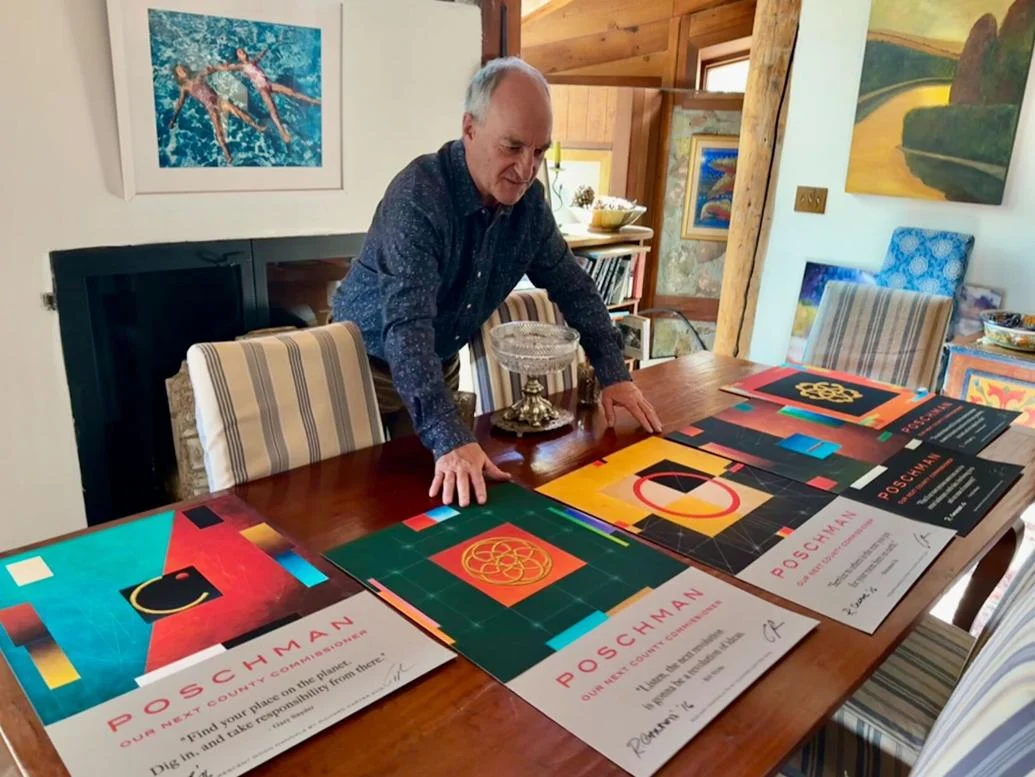
Greg Poschman, the unopposed incumbent Pitkin County commissioner running for his third and final term to represent District 3, likes to say that his most important constituents are the local elk herds.
“I tell people that my primary constituents are the elk,” he said. “I say it in jest, but wildlife habitat, the prosperity and maintaining herds of wild animals — whether it’s bird life or [mammal] life — is really important to me.”
Before first running for office in 2016, Poschman spent his career as a filmmaker. He grew up in the Roaring Fork Valley and pivoted into local government at the advice of a client, then the prodding of friends.
This race and his previous run were uncontested, which Poschman calls a travesty and chalks it up to folks’ reluctance to do some dirty work.
“This is a community that’s full of such incredible quality of life, who wants to deal with the mundane things and the problems?” he said. “I think we have a community that probably largely doesn’t want to be involved, and I think that’s unfortunate. It’s a travesty to have a representative democracy and be running unopposed.”
In his past eight years on the board, Poschman said the conservation of open spaces is among his proudest achievements. The 800-acre Craig Ranch conservation easement and the record-setting Snowmass Falls Ranch acquisition were highlights, he said.
Looking ahead, Poschman wants to keep the board’s eye on Lincoln Creek, which has been found to have high rates of mineral contamination that may be causing fish kills and other problems in the watershed.
“We’ve had a toxic mineral release, which we suspect is a natural occurrence possibly caused by climate change, warming permafrost. There are also mines up there that could be leaching toxic minerals into the water,” he said. “But what we do know is it’s compromising the quality of the water up there. It killed fish, the first fish kill I have ever seen in my life on the Roaring Fork, and I grew up living right on the Roaring Fork River.”
While Poschman recognized that conservation and open space are universally popular priorities for the county, nailing down a position on the future of the Aspen-Pitkin County Airport was trickier. Poschman voted to approve the language of ballot question 1C, which seeks to “reaffirm” the county’s authority over the airport.
The commissioners unanimously approved 1C after a citizen group successfully put a ballot question on the November ballot earlier this summer, question 200, which seeks to divest the commissioners of their power to alter or relocate the airport runway without a secondary vote.
He said he thinks a lot of the community response is based in fear and emotion, a community that doesn’t like being told what to do. While empathetic to that position, Poschman said it’s irresponsible to flout the federal agency here.
“We’re working with federal and state agencies who really didn’t come to ask us what we wanted to do; they’re coming to tell us what we need to do,” he said. “We can’t really just go tell the federal government or the state to get stuffed while we do our own thing. That’s just a myth that we can do that, and I’m certainly not going to because I think it would be a breach of fiduciary responsibility and probably legal requirements.”
Poschman and the board faced blowback after they unanimously approved the initial phase of a special use permit application from Belly Up Concerts LLC to pursue a 16,000-person two-weekend concert series starting summer 2025.
“We don’t get those administrative approvals kicked up to us that often. Honestly, I think we were taken by surprise,” he said. “I apologized, not only on behalf of myself, but also on behalf of the board, because I didn’t feel that we had had a significant time to really understand the consequences.”
The outcry from the local nonprofit arts and culture community prompted a second discussion and a pared down plan for the first year. Poschman expressed regret over his initial approval and voted to have a formal second discussion, which was ultimately voted down by the board.
He said that while he trusted the Goldbergs, the family behind Belly Up, to do a professional job, he wants more public input on big questions like the concert application.
“We rely on the public input. We’ve got to give the community a chance. Because honestly, you put things in the paper, you broadcast it in the agendas, it’s all published,” he said. “And people say, ‘Wow, I never heard about that’ after the fact. And you think, what do we have to do to get people’s attention here?”
Post-pandemic, Poschman said he’s seen a growing demand on county services and along with that a growing budget.
He said he’s grateful to organizations like Roaring Fork Safe Passages, a local nonprofit studying wildlife safety and Highway 82 crossings that intends to pursue a major project and funding through the Colorado Department of Transportation.
“When a group comes along, a nonprofit, whether it be CORE, a super-important group locally and very smart and doing great work, or Safe Passages … if these nonprofits we work with can come along and do the job so we don’t have to hire more staff, that’s a total win for the community,” he said. “It costs us less. They’re working in an environment where they actually have to go out and compete for the funding, so they’re on their toes.”
While Poschman was perhaps the most apprehensive about ballot measure 1A, the county question asking for a new property tax to fund county affordable housing initiatives, he ultimately voted to endorse it.
“I don’t want to do it unless we are taking care of perhaps the most essential, important needs that we have,” he said. “I’ve been the one pushing hard that we have a priority in the county’s housing to house people that we need to keep the wheels on, the people who make this place work: snow plow drivers, bus drivers, deputy sheriffs, ambulance workers.”