
ROARING FORK BROADCASTING COMPANY



Increasing class sizes, cutting athletic coaching positions and cutting some excess operational costs could save the Aspen School District millions of dollars, district leaders said.I think we’re going to have a really awesome show not only in X Games this week but also next week in the Grand Prix.”
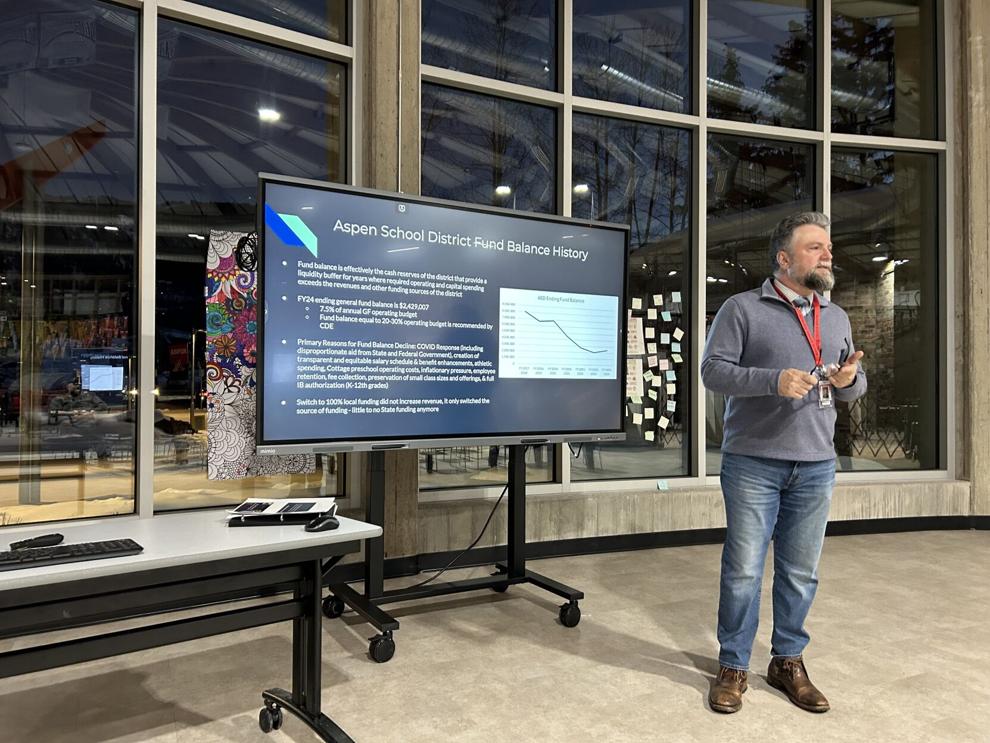
But those changes don’t come without tradeoffs, and ASD will need to balance staff, teacher and community priorities when deciding where to cut expenses, Superintendent Tharyn Mulberry said during a town hall about the district’s financial situation on Thursday at Aspen High School. District officials held the town hall to maintain transparency as it works to rebuild its reserve balance that decreased 75% in the last five years to a precariously low amount.
Mulberry and district financial leaders explained how the district allowed its reserve balance to decrease from $8 million to about $2 million from 2018 and how it was planning to save money, with the ultimate goal of increasing staff salaries to make ASD teachers the highest-paid in the state.
“If we left (the reserves) as it is, next year when we come in to try to get the teachers raises … we would not be able to do that,” Mulberry said.
Mulberry anticipates the Aspen Education Association, the district’s teachers union, to ask for a minimum of 3.5% raises for staff. AEA negotiates salaries and benefits with the district every year.
Increased curriculum expenses, disparities in federal COVID-19 aid distributed to ASD, raises to “rightsize” staff salaries that hadn’t seen appropriate increases and high turnover in the district’s top financial position created a “perfect storm” for the district’s reserves to decrease so much and so quickly, ASD Superintendent of Business Mary Rodino said. Three people held the superintendent of business position, essentially the district’s chief financial officer, in three years, she said.
“I think without consistent leadership who said, ‘Hey stop (spending),’ which is kind of what we’ve been saying this year, it’s difficult,” Rodino said. “Without financial leadership, timely audits, things that were happening in this small, rural kind of end-of-the-road district for half of the year, affected all of that.”
Inflation also played a role in the increased spending. Cost increases for food, construction supplies, fuel and more increased disproportionately to district revenues. The state’s school-finance formula limits how much money districts can collect, even when costs are increasing for the district in the periphery.
The district didn’t react to the expenses in the moment because “we didn’t have the specificity of the accounting that we have now,” Mulberry said. Moody’s Investor Services, which rates the credit of institutions, downgrading the district’s credit rating last spring because of the low reserve balance served as a “wake-up call” for district leaders, Mulberry told Aspen Daily News in an interview.
“That’s what started and created these conversations,” Mulberry said.
An expense-cutting task force created in the fall was tasked with identifying areas in which the district could cut costs to rebuild its reserve balance $700,000 to $1.5 million in the next fiscal year. Initial conversations among the task force and a survey of staff and administrators identified some operational costs that could save the district several hundred thousand dollars annually.
An analysis of district funds and expense-cutting measures also found that increasing the student-to-teacher ratio from the current average 11:1 to 14:1 could save $4 million, Josh Anderson, a math teacher at Aspen High School and AEA vice president, said during the town hall. The state’s average student-to-teacher ratio in similar size schools is 14:1.
But, Anderson said, in conversations with teachers over the past two weeks about how the district could tackle saving costs, many teachers did not want to see significant class-size increases, even if it meant raises.
“There’s a little bit of wiggle room, I think, in that classroom-size number and that’s what we heard from teachers,” Anderson said. “Teaching staff ended up saying, ‘I’d like a little bit of a raise, but I don’t want my job to get so crazy.’”
Average student-to-teacher ratios in the elementary, middle and high schools are either within or below school board-recommended ranges for classroom size. Small class sizes is a board mandate that is meant to maintain a successful educational environment.
Staff members were receptive to the idea of cutting certain operational costs and increasing the district’s athlete-to-coach ratio, which is quite small for ASD’s size. The district currently has an average 7:1 athlete to coach ratio. ASD would not cut athletic programs, but would look to increase that ratio to save more.
The district is not conducting layoffs. But it will likely not rehire for positions it loses through attrition, Mulberry said.
The district loses about 17 to 20 staff members per year through attrition, and it is currently looking like it will lose seven to 10 positions this academic year, Mulberry told ADN. Those positions will not be replaced, and they are from several departments, including facilities, early learning child support and a few assistant coaches.
The expense-cutting task force will make recommendations to the school board in February. The district is soliciting recommendations from community members, and will likely prioritize recommendations that align with what staff members have suggested they would support.
Saving will be especially important in the next fiscal year because of increases to the district’s health insurance premiums. Health insurance premiums will likely increase 25%, ASD Human Resources Director Amy Littlejohn said at the town hall, an additional cost that will be passed onto employees because the district does not have the money to cover it, she said.
The district will also need to lean on community support in the coming year, as it looks to renew the Aspen and Snowmass public education fund taxes, extend a mill-levy override and potentially pursue another bond measure in November.
“I just want to make sure that we’re good stewards of the public money as we go forward,” Mulberry said in an interview. “I want to make sure that we do not lose all the quality programs that the Aspen School District is renowned for, and not only that, (make sure) we have the money to continue to improve and do great things."